SUPERHERO
“She can be whatever she makes you think you want her to be.”
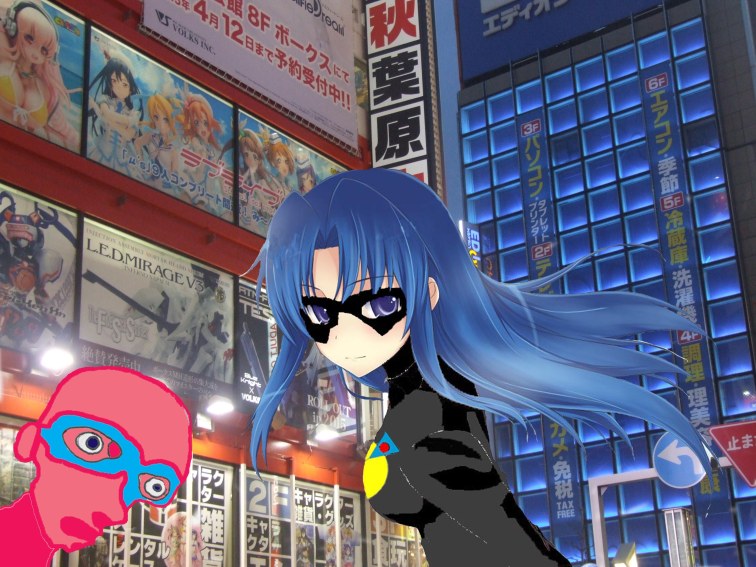
Illusory Girl paced around her superhero’s den hidden under the streets of Akihabara, Electric Town.
She was waiting for her sidekick, Bubblegum Boy, and the kid was late. Maybe he’s got stuck in traffic, she thought, or more likely got stuck under a table or on the sole of someone’s shoe.
Why did she have to have a sidekick anyway? She could create any illusion she chose and so could make her own sidekick and make him totally punctual. Why had the League of Costumed Crimefighters (Tokyo Branch) insisted on her mentoring Bubblegum Boy? It wasn’t as if his so-called superpower was any good. He could blow himself up into a bubble. He could stick to stuff. He could change shape and stretch himself into a long strand or become spherical. After any of these actions he could twang back into his original shape. So what? He could reconfigure his facial features for the purposes of impersonation. That could be useful but without one of her illusions his skin colour would give him away. After his transformation into Bubblegum Boy he was always the bright pink colour of fresh bubblegum. More often than not he was a liability.
He was a ridiculous protégé but she did feel responsible for him. She would usually create a special sub-illusion just for him so he would think he had played a major part in bringing down their latest villain. If, as usual, she’d had to rescue him, she’d block his memory. She didn’t want to deflate Bubblegum Boy however annoying he could be.
Illusory Girl was in full costume. Her sidekick was a kid of eleven or thereabouts and she had to keep her identity secret. If he knew her alter ego he’d blab it all around his school, his street, his ward until all Tokyo knew who she really was. She paced some more; her exasperation showing on what was visible of her face beneath the blue wig and domino mask.
After another five minutes she heard the lifting of the street manhole cover which was the secret entrance to her lair. It clanged shut and a pink ball fell from the hatch, bounced as it hit the floor and then reformed itself into the shape of a boy. This was one of his ‘special moves.’
“Hi,” he said, his voice not yet broken. Even in his normal (but bright pink) shape he was quite rotund. His costume consisted of baby blue domino mask and pants. The effect was quite unsettling.
“You’re late.”
“Sorry, Illusory Girl. I was guest of honour at a confectionary convention and couldn’t prise myself away.”
“Bubblegum Boy, we’re needed.”
“Another supervillain to bring down, Illusory Girl?”
“Yep, they keep popping up and we keep knocking them down.”
“Who is it this time?”
“A global crime boss but a creature of the shadows. He’s only just come to my attention.”
“How, Illusory Girl?”
“I was after this extortionist working Kabukicho and made him feel totally stressed out so that he’d desire a massage. So, I created this sting illusion of a massage parlour and I was the masseuse. Why are you smiling Bubblegum Boy?”
“I hope this story has a happy ending.”
“I don’t get it.”
“So, what happened?”
“Well, he’s on the table…”
“He’ll have been really tense from his day of hustling on the hard streets of Kabukicho.”
“Yes, he was, Bubblegum Boy. Why are you finding this all so amusing? Anyway, he let slip…”
“Under your firm but probing fingers?”
“Under the illusion of my firm but probing fingers, yes.” Illusory Girl was getting annoyed by the constant interruptions which she was beginning to suspect of a smutty subtext. “He let slip that he wasn’t his own man. He was working for someone higher up the criminal food chain. And this boss was huge both in the scale of his illegal enterprises and in his physical size. He said that this crime lord had such a vast girth that it would take a team of girls like me to simply do his back.”
“I bet he was relieved to get that off his chest.”
“So I set about finding out more about this newly exposed criminal mastermind.”
“What’s his name?”
“Okii-san, Mr. Big.”
“Of course it is. So, whaddyaknow?”
“Mr. Big, is, like, the size of a house.”
“What, like the size of his own house?”
“No, Bubblegum Boy, of course not. How would that work? No, he’s as tall as an ordinary two-storey house and as wide as, say, two tatami mats.”
“Wow! How did he get that size?”
“No one knows. He probably eats more than his fair share of this fragile planet’s resources but that wouldn’t account for this kind if size. This isn’t a case of giantism but giganticism. Is he a genetic mutation? Was he bitten by a radioactive whale as a child?”
“More likely he ate some radioactive whale.”
“Hmmm, as a humble worker in a pharmaceutical company did he fall head first into a vat of growth hormones?”
“Has he been stretched on a rack by over zealous European Middle Ages style torturers?”
“Anyway, Bubblegum Boy, however he got so big he is now in sole charge of a fittingly vast criminal organisation. He started by controlling a string of Pachinko parlours but now his reach is, if not quite literally, global.”
“His fingers are in all the pies.”
“Indeed. He manufactures every prohibited substance you’ve ever heard of and even more you haven’t. His fleets of container ships move them around the world to where they’ll make the biggest profit. He owns banks and has gangs that rob the banks he doesn’t own. They steal, plunder and pillage in every country in the world. Mr. Big employs fences, extortionists, prostitutes, and his match fixers are busy in every sport. His domestic help are all ex-Sumo wrestlers. His personal bodyguards are all ex-army or Ninja.
“One of his biggest earners is counterfeiting. His printworks copy money, bonds, event tickets and high-end brand packaging. His factories churn out fake perfumes, watches, tech, and designer fashion.
“A very profitable line in this day age is people trafficking. It was whispered on the street that he moved more people around than Japan Railways. But with a much poorer survival rate. That terrible sinking last week off the Australian coast? That was one of his. We have got to stop this man, Bubblegum Boy.”
“OK,” was all he said and stretched out one of his arms to three times its normal length to grab a bottle of fizzy pop from Illusory Girl’s kitchenette.
“As you can imagine he doesn’t get out much. Why have henchmen and go to the shops yourself?”
“Especially if you can’t get fit inside any shops.”
“Yeah, so he bought an entire apartment block in Roppongi. He removed some of the floors and reinforced others. He’s got belts and straps suspended from cables under the ceilings to take some of the weight as he moves about. Industrial freight elevators were installed to move him between floors. His bedroom on the top floor has a supersized bariatric bed affording him one of the best views over Tokyo.”
“How do you know all this?”
“I went out there after school.”
“You’re still at school, Illusory Girl?”
“I might work in a school, Bubblegum Boy. May I carry on?” She tried to cover up her stupid error but to preserve her secret identity she might have to overwrite part of his memory later with a small illusion. “I had to check it out. From a distance Mr. Big’s secret lair looks like any apartment block in that prestigious part of the city but for the people living nearby his presence can’t be ignored.
“I’d heard all these whispers about him but none of the gossip and scare-mongering had prepared me for his sheer size. He is built like a bath house constructed from a solid and durable material such as, say, brick. He can be seen moving about inside but only part of him can be seen through one window at any given time. The wire assists fastened to his arms and legs make him look like a huge puppet. But he is no one’s puppet, Bubblegum Boy; he’s the one pulling the strings. You can see the vast array of screens helping him keep in touch with his organisation.
“I got a good look at him, especially if he turned to look out. He wore a white shirt and black tie and a black business suit.”
“But, and I’m guessing here, bespoke? Size XXXXXXXXXXXXXL?”
“His face filled one of the windows. He was wearing a black domino mask.”
“His anonymity is important to him?”
“You won’t think it so amusing when you see him. He’s very intimidating. Whatever illusion I come up with is going to have to be, er, supersized.”
“Yeah, but please let me do more this time, Illusory Girl,” he pleaded. “Give me a bigger role. I’ve shown I can handle it.”
This, she thought, was the problem with deluding him about his capabilities. She doubted he was up to tackling this super-adversary. Still, a protégé did have to learn.
“Let me chew it over, Bubblegum Boy,” she said.
After Bubblegum Boy had bounced back to the surface for his next appointment (as patron of the Clean-Up the Streets Campaign) Illusory Girl was left to seek advice from her three guardians.
She pressed a concealed button and part of the wall slid open. She entered a wood-panelled room. The door quietly shut behind her leaving just enough light to see by. She lit the incense sticks and candles that were needed for the Summoning. She squatted in the centre of a large mandala painted on the floor. It was the same symbol as she wore emblazoned on her chest.
After ten minutes of incantations the air itself seemed to shudder. With a slight pop three figures simultaneously materialised in the room. Each hovered in a lotus position inches above one of the three circles-within-triangles of the mandala.
These were her guardians, three of the Secret Masters of Shambhala who had plucked her from obscurity to give her the superpower that made her Illusory Girl. It was they who had given this ordinary Tokyo schoolgirl the ability to create thought-forms or tulpas which were realistic in every detail.
“My child,” the thought appeared in her mind. Had it come from one or all of them? She didn’t know which was the most disconcerting: the telepathy or the floating.
“The floating,” the thought appeared; which rather proved it to be the telepathy. But the mind-reading did mean she didn’t have to outline the problem. They immediately knew as much about Mr. Big (and his security) as she did. The three ancient sages bobbed about a bit as if they were conferring.
“Trust the boy to find the gate.” Their advice could have been ambiguous mysticism but the image popped into her head of a Pachinko Parlour. She was all too familiar with the game having watched her mother play for hours; forced to sit on her knee and watch the housekeeping money disappear. But now her knowledge had come in handy. She knew the nature of the gate through which the boy must pass.
With only the finer details of the plan to work out, the manifestations of the Secret Masters winked out as they returned to their physical bodies in Shambhala. As far as Illusory Girl knew this was in a remote Himalayan valley but her guardians did not tell her everything.
The following day was a Saturday and Illusory Girl and Bubblegum Boy spent the afternoon planning in her secret H.Q.
In the evening they set out for Roppongi. So as not to alert the target she had created an illusion so they looked like a perfectly ordinary brother and sister as they rode the subway across town.
It was turning to dusk as they arrived at Mr. Big’s block and the whole building was illuminated. Light poured from every window. The blue neon box on the roof kept scrolling through its advertisements. Mr. Big could be seen in the middle of the building. He was talking into a headset. He moved back and forth in front of huge flickering video screens.
“So, you remember what you have to do?”
“Don’t be cheeky, Bubblegum Boy. Do you remember what you have to do?”
He smiled, doing that scary thing when his grin stretched right round his head to meet at the other side.
They watched the building for a while and timed the foot patrols that were Mr. Big’s first line of defence. In a suitable interval they sidled as inconspicuously as possible to the base of the building.
“Now,” said Illusory Girl and created the primary illusion. This was a favourite of illusionists throughout history and was known simply as multiplicity.
Suddenly Bubblegum Boy was surrounded by hundreds of identical copies of himself. The illusion was created with exaggerated attention to detail. She produced on her own what would take whole teams of animators at Dreamworks. Skin had pores, bodies had perfectly rendered shadows and hair wafted in time with the breezes. The new Bubblegum Boys were so accurate that Illusory Girl couldn’t tell which was the real Bubblegum Boy. Only he could know (she hadn’t gone so far as to replicate his consciousness in the copies.)
She opened up an illusory manhole cover by the wall.
“Quick,” she said, “before the next patrol comes round.” All the Bubblegum Boys made themselves completely spherical and jumped one by one down the hole. She slammed the lid down after the last one and made her way back into the shadow of the opposite building just as the next guard rounded the corner.
There she waited silently as the Bubblegum Boys were drawn up inside the building within the hidden ducts she had thought into being. Seconds later and pink Bubblegum Boy balls started falling from holes in the ceiling of the top floor to cascade down through the whole apartment block.
It was as if she was watching a huge Pachinko machine. The video screens now showed three huge numbers surrounded by flickering animations. Hundreds of smiling pink balls were falling and bouncing around within the rooms. They rebounded off the furniture, walls, henchmen and Mr. Big himself. A bell rang every time he was hit and one of the numbers would revolve like a digital fruit machine. Mr. Big crouched down and covered his ears with his hands. He was trying to make himself smaller to avoid the hits and protect his hearing.
Like a real Pachinko Parlour the noise was deafening. As well as the bells and pings and whistles there was the odd snatch of barely recognisable J-Pop or very loud Thrash Metal. The whole building sounded like a vertical fairground and had the flashing lights to go with it. The cacophony brought people from his neighbouring blocks out onto the streets to see what was happening.
Totally one of my most successful illusions, she thought, but could her sidekick topple the big guy?
Mr. Big was hit by a bouncing Bubblegum Boy and the middle number of the three started to whirl round very fast. It slowed and stopped and it matched the numbers on each side of it. The volume of the music went up a notch. The numbers vanished to be replaced by an animation. The balls continued to rain down as an animated Lolita caused animated mayhem with a big gun. Illusory Girl did not take her eyes off Mr. Big. The machine had entered a Time Reduction Mode. She found she was clenching her fists.
“C’mon Bubblegum Boy,” she shouted.
Mr. Big took his hands away from his head and straightened up. He looked around at the chaos that surrounded him, His mouth opened in awe and wonder and – in that second – one of the Bubblegum Boys popped right in and didn’t bounce out again. Illusory Girl actually jumped up and down in excitement; the ball was in the gate!
It didn’t seem possible that the music could get louder or the building light up any crazier but it did. The animation on the screens changed to show the internal organs of (presumably) Mr. Big. Bubblegum Boy was falling down his gullet. Then, somehow, he moved from the digestive system and, losing his ball-shape, he wrapped himself around Mr. Big’s heart and squeezed until it could no longer pump. All this was shown as a grisly animation to the Roppongi crowd. In front of the screens Mr. Big had slumped to his knees before keeling over completely.
Jackpot!
Illusory Girl created more holes in the foot of the building and the Bubblegum Boys started to fall out. She strode out of her hiding place to meet them. Soon she was surrounded by hundreds of Bubblegum Boys bouncing up and down shouting “hooray!” Dejected henchmen shuffled out of the main door, throwing down their weapons, to be rounded up by the cops who had (eventually) arrived to see what the racket was all about.
For a while Illusory Girl basked in her success. Then she shut down the multiplicity illusion. The copies of her protégé vanished and Bubblegum Boy himself was left standing beside her. The apartment block had reverted to Mr. Big’s home and his video screens now only showed abandoned offices and graphs of tumbling stock market prices.
Mr. Big’s corpse could be seen through a row of windows. Soon, crime scene investigators would be crawling all over the black-suited body.
“Time to go, Bubblegum Boy,” said Illusory Girl. “But first – high five!” A very pleased Bubblegum Boy bounced in the air to slap her outstretched palm. This was praise indeed.
“Another criminal empire smashed,” he said and his mentor triggered the illusion that they were ordinary citizens to allow them to mingle inconspicuously with the crowd.
Whooooooooooooooooooooooooooooooooooooooooooooooooooosh.
Nine time zones distant and the League of Costumed Crimefighters (Hull Branch) were on red alert. A mass break-out from the supervillain wing of Hull Prison had already resulted in a city centre jewellery heist, a bank robbery and the placing of a traffic cone 102 feet up on the head of the William Wilberforce monument.
In their homes throughout the city the superheroes, cosy in their domestic identities, were summoned to their HQ.
Those capable of flight were scrambled first and they took on their opposite numbers in a spectacular aerial dogfight over Alfred Gelder Street. The ground-bound forces of good and evil clashed in a running battle beneath them.
Feyderbrand was protected by his dream suit and thus unaware of the chaos going on all around him in his adopted city. A check on the current genre, however, brought him running out of his office. The technicians gathered before him. They hadn’t seen Feyderbrand so angry since the Brexit vote. His face was white and he couldn’t stop pacing up and down before them.
“Superhero?” he shouted and the first man in the line of white coats was flecked by spit. “Superhero, how long have we been in Superhero?”
“Two days, sir.”
“And why wasn’t I informed?”
“We’ve been trying to locate the problem, sir. It’s been very difficult, even unprecedented. We’ve had to correlate the machine’s own log with, er, wider events. Tokyo, sir, as well as nearer to home.”
The technician’s stumbling explanation tailed off as something caught his eye. Feyderbrand turned around to follow his gaze. Pierre Brodeur and Demi Leather were striding towards them clasping print-outs. He turned to them, shouting:
“Superhero? How can we be in Superhero? Has that idiot Hasenkamp been messing with my machine again?”
“No sir,” said Brodeur as he and Leather joined the line of technicians. “I’m afraid it’s much more serious than that.”
Feyderbrand moved to stand right in front of this one of his number twos.
“Explain.”
“We have lost control of the machine. It is now choosing its own genres, seemingly at random, and at random intervals.”
Feyderbrand stared at him aghast.
“We,” chipped in Ms Leather, “are perfectly immune here in our dream suits but…”
“Out there…” Feyderbrand couldn’t finish his own sentence.
“Exactly.”
Feyderbrand struggled to imagine the consequences once the generic codes governing the creation and interpretation of signs could be switched at the whim of the machine. Superhero might be just the beginning.
“How did this happen?” He was calmer now and needed answers.
“Something completely unforeseen occurred. Nothing in the risk assessment prepared us for this,” said Demi. “We were in one of the quiet genres. Romance, sir, is a favourite of much of the team.”
The technicians all nodded their heads in agreement.
“Yes, yes,” said Feyderbrand impatiently. He was perfectly familiar with the soft-hearted leanings of his scientists.
“And someone, out there, chose to dress up as a superhero,” said M. Brodeur.
“For a costume party?”
“That sort of thing. But she chose an obscure Japanese superhero from one of their anime series. It is hardly known over here. This couldn’t have been anticipated.”
Now the technicians were frowning and shaking their heads.
“And this superhero,” Demi took over the explanation, “Illusory Girl, has the ability to shape shift and create illusions. In short, sir, she manipulates her victims in order to trap criminal masterminds.”
“So?”
“Created a feedback loop, sir, is all.”
“Significations are starting to feed off each other?”
“As always, sir, but in this case the choice of the syntagm ‘Illusory Girl’ by this schoolgirl in the Romance genre produced a rival semiotic system to our machine. The referent itself is generating the codes.”
Pierre returned to the fore: “And that includes the settings of our machine…”
“Which in turn affects the form of the sign…”
“Which determines the meaning of the sign, yes, yes, I get it.” Of course Semiotician Feyderbrand got it. Nevertheless Ms Leather felt the need to clarify:
“The illusion-generated illusion of ‘Illusory Girl’ ceased to be an illusion when the feedback loop caused the machine to go into the Superhero genre. Illusory Girl came into being and her illusions included a game of Pachinko. This has introduced an element of randomness into the whole self-referencing system of genre selection. Now anything can happen.”
Anything could happen. Feyderbrand felt he was no longer standing on firm ground. Reality was shifting for him too despite his dream suit. His next question did not seem very relevant but he was desperately trying to anchor himself to a world he could still recognise.
“Who is the girl who has caused this terrible malfunction?”
Demi Leather consulted her print-outs.
“She goes by the name of Sasha Spence, sir. She lives not far away on the other side of the river.”
“Is she working for the Americans?”
“Oh, no, sir. She’s just a teenage girl.”
Just a teenage girl, thought Feyderbrand, and yet she had ruined all his life’s work with one bizarre choice. His beautiful machine had never been given a name. As semioticians they all knew the power of names. But everyone also knew it was Feyderbrand’s pride and joy. He still knew what they had to do.
“Shut it down,” he said.
The machine couldn’t be unplugged. It had its own internally generated power supply. In order to turn it off three keys had to be turned (in the possession of Feyderbrand, Leather and Brodeur) and a big red lever had to be pulled. Without further discussion the three key-holders turned their keys. Pierre Brodeur moved to pull the lever.
Before he reached it the machine bleeped and a new array of LEDs indicated a change of genre.
“Oh, what now?” cried Feyderbrand. “Disaster?”
“That wouldn’t be random, sir. No, we’re now in Magical Realism.”
“Try it, Pierre,” said Feyderbrand but his voice betrayed his despair.
Brodeur grasped the lever with two hands and pulled it down. Nothing happened. Lights still flickered on the displays and the machine’s usual sounds of activity continued.
Demi Leather spoke out: “I don’t get it. We’re not in Magical Realism. Out there might be but we’ve got protection. We’ve got our dream suits. Why can’t we shut it down?”
Nobody could answer her.
MAGICAL REALISM
As Feyderbrand and his team puzzled over their rogue machine and street cleaners swept Alfred Gelder Street, Sasha Spence was in her bedroom getting ready.
From the paradigm of footwear she had little trouble choosing her DMs and leaving her ‘sensible’ shoes and trainers in the bottom of the wardrobe. The shoes had been bought for her Gran’s funeral and the trainers she’d worn before becoming a Skingirl. She teamed the boots with black tights and a short skirt.
Her selections from the paradigms of top and jacket were more difficult. She was to spend the day with Joe and his grandad. It was worth taking time over her outfit; she wanted to make a good impression on the old geezer who meant so much to Joe.
She opted for a checked button-down shirt with the top button done up. Her paradigmatic choice of smart suit jacket was preferred over the bleached denim jacket (too skinhead) or the olive green flight jacket (too “Oi, are you looking at me?”) or the Harrington (Joe was wearing his, they’d liaised). She added a red handkerchief to her breast pocket (it was actually a fake one with a triangle of red cloth mounted on cardboard.) Her hair had been cut by her mother the day before. She applied lipstick and eye makeup.
Sasha looked at herself in the full-length mirror and was pleased with the effect. She had created the perfect syntagm of visual signifiers meaning ‘Skingirl’. Of course, she didn’t think that in so many words.
She shouted goodbye to her Mum and left the house to call for Joe. When she turned the corner into his street she saw he was already standing by his gate. When he saw her he smiled and waved. She was pleased to see he was wearing his beige Harrington with a black Fred Perry polo shirt.
“Wotcha,” she said and they kissed. She did an exaggerated look around. “Where’s grandad?”
“Today’s the day he helps out in the cemetery. We’ll have to go and meet him there.”
“What, he’s like a gravedigger?”
Joe laughed. “No, no, it’s an old cemetery. He helps tidy it up, cutting back the brambles and that. Come on.”
They cut through the estate and headed East to Wincolmlee and the river. They paused by Wilmington Railway Bridge and looked up at the massive British Extracting Co. building on the other bank.
“And that’s the place you want…”
“Yep.”
“That is one steep staircase.”
“Yep.”
“Very exposed.”
“Yep.”
And that door at the top actually opens?”
“I don’t know. That’s part of the thrill.”
“Hmmm.”
They walked north along the west bank of the river opposite the silo.
“It has been done before, some time ago,” said Joe. There are photos of the inside on one of Marc’s Urbex websites and some night views taken from that arched structure holding up that water tank or whatever it is.” He smiled at her. “The view will be fantastic from up there.”
“Hmmm.” Sasha wondered how she’d got dragged into this latest crazy adventure which had now been scheduled for the first day of the spring holidays.
In a break in the traffic they crossed the road and turned left into Air Street. Joe noticed Sasha wrinkling her nose.
“The tannery,” he said but Sasha’s attention was grabbed by something else. There was a small graveyard on the other side of the road and she saw something crimson move behind the trees. Joe’s eyes followed hers but obviously saw nothing untoward.
“That’s not the cemetery,” he said. “Ours is further along.”
They had to turn a corner onto Sculcoates Lane itself before she could see the northern part of Sculcoates cemetery. The gate squeaked loudly as Joe pushed it open so that anyone (alive) inside would have plenty of warning of new visitors. The cemetery was overgrown but paths were visible and some of the headstones.
“Grandad?” Joe called.
“Over here,” was the answer and they took the left-hand path. After a couple of twists and turns they found Joe’s grandad standing and rotating his shoulders as if to ease his aching muscles. He greeted them with a wide grin.
“Hello, Joe, and you must be Sasha. My, you didn’t tell me she was this bonny.”
Joe admired his grandfather’s opening line but, in fact, he had told him she was that bonny and had even shown him photos on his phone.
“Interesting place,” said Sasha looking around.
“Aye, let me show you around.”
Leaving his jacket lying on the grass he took them on a circuit of the old cemetery taking pains to show them the small headstones of the workhouse inmates.
“There’s about two hundred of them, usually with three names on each. Very unusual as paupers were usually buried in unmarked graves.”
Sasha and Joe waded through the long grass to examine some of them. Returning to their guide Sasha asked about wildlife.
“That’s why we haven’t completely tidied it up. There are foxes and all sorts of birds. We are trying to keep the paths free of brambles so you can get round but the rest we leave. Oh, and there’s some Japanese knotweed we have to dispose of.”
Where they were standing was overlooked by new housing.
“Used to be Needler’s sweet factory,” said Joe’s grandad. “All manner of confectionary was made there.” Joe and Sasha both (but independently) found themselves thinking of golden tickets, an eccentric (but benevolent) top-hatted entrepreneur and an orange-skinned mini-sized workforce. Such is the power of cultural hegemony.
They completed their circuit of the cemetery and arrived back where they’d started. Joe’s grandad picked up his jacket.
“We’d better be off. We have quite a walk ahead of us if you’re going to see something of Hessle Road. Glad you’re both wearing your walking boots.”
Sasha exchanged glances with Joe. The plan was to head off down Beverley Road and make their way over to Hessle Road and the Fish Docks for some “proper” history. Joe had told her he loved these walks with his grandad but had warned her it was an excuse for a string of reminiscences. He’d compared his grandad to “one of those blokes conducting a ghost walk but with all the ghosts being dead shops.” She smiled as she thought of it.
When they got to the grand entrance to Pearson Park Joe’s grandad said:
“We’ll go through the Park and along Prinny Ave. The centre of town’s a no-go.”
“How come?”
“Massive clean-up needed in Alfred Gelder Street. Lots of roads closed.”
“Oh, yes, the circus…”
“Well you can call it a circus, dear, but it wasn’t a proper circus. A proper circus has got some bloke’s name in the title like Bertram Mills or Billy Smart. If the words ‘State Circus’ feature it’s not a proper circus.”
“What about…?”
“Now, Joe, don’t get me started on Cirque de whatever. It’s like they’re ashamed to be a circus. That’s what they had downtown last night: acrobats wearing crazy costumes zooming about on wires scattering stuff over a street full of clowns. Cirque de Bollocks if you ask me. I stayed at home. They left a right mess.”
Fully apprised of what makes a proper circus, Joe and Sasha followed their guide into Pearson Park where they kept to the road. Joe told his grandfather they knew the Park very well but carefully steered the subject away from their lager-fuelled gang moots. They passed the Mosque and the tree sculpture and stood for a couple of minutes outside number 32 for Joe’s grandad to enthuse about Philip Larkin. Then they rejoined the bustle of the “cut-price crowd” on Princes Avenue.
“Over there’s Ray’s Place. Have you taken Sasha there yet, Joe? Glad to hear it. French before that: Restaurant Duval if I recollect. Before that: the Book and Record Exchange. Some of my records still bear their stamp on the inner sleeves.” Sasha looked as blank as the cover of the Beatles’ Double White album but Joe’s grandad ploughed on: “There didn’t used to be any restaurants or bars along here except for the Queens’ back there. Now look at it.” They looked at it. Further along: “That place there used to be a Tex Mex place called Chaplin’s. Your Mam loved it; it had a nice American theme going on. If it was your birthday the owner would plonk a sombrero on your head and a sparkler in your dessert. He liked shooting magnums and I don’t mean the ice creams. Used to like showing you a fistful of bullets. Liked his guns and went to Florida every year. I wonder what happened to him. He sold up just as Prinny Ave started to take off. Before that it was Pantomime. Sold clothes and stuff. Always smelt of patchouli. Since Chaplin’s it’s been lots of different restaurants. One of the longest lasting was a Chinese called the Giant Panda. On your card receipt it used to say Giant Pandana. Your Nana and me always called it that. Wish there was still a Chinese along here.”
But Joe knew that his grandad had no one to go with to a restaurant any more. Every now and then he might splash out on a takeaway. He and his mother must take the old guy out more, Joe thought. He deserved it.
“See that bakery there? Used to be called Arnett’s. On a Friday night, well, more like early the next morning, you could queue up at their back gate and get a fadge. That were a big bread cake full of meat or cheese. Freshly baked so it were still warm and it really filled you up.”
Joe knew his grandfather sometimes drank in Pave but they passed by with only a glance inside and paused by the big Toad sitting outside a massive pub called Pearson’s.
“There used to be some real quirky little shops round here: Page One Bookshop, Bogus, Zebra, a shop for home brew kits, a shop selling stamps and cigarette cards – for collectors, you know? – and a second-hand record shop called Not Karen’s But Norman’s Place. For clothes there was Christina Artwear and there was Gwenap of course (a throaty chuckle). Round the corner was a socialist bookshop. Bygone days, you might say.”
On the other side of the Avenue was the terrace of shops. Now the only sign of quirkiness was the subsidence which had buckled the shops into meeting their neighbours at odd angles. There were plenty of opportunities to eat here and be groomed: a person could have their hair cut or extended; their skin could be inked or pierced.
Our walking party turned their backs on these possibilities and turned onto Spring Bank and then down Derringham Street. Sasha knew better than to flash the fags in front of Joe’s grandad. Instead she proffered each of them a stick of Hubba Bubba which they took.
“As long as you don’t swallow it,” advised the old man.
“Tell her about the Bubblegum Boy, grandad,” said Joe, smiling.
“Oh, aye, well, Sasha, see, there were this little lad, only twelve, and he died after swallowing his bubblegum. There’s his gravestone in Hedon Road Cemetery. It’s vandalised now and only his legs remain but it used to be a statue of the little chap wearing his school cap. It’s said that he had marbles for eyes but – ” he shook his head. “Anyroad, mams would frighten their bairns with this story so they’d never swallow their gum. It was mostly an East Hull thing but tales like this spread in the seventies. Kids would frighten each other with stories of the ghost of Bubblegum Boy which haunted the cemetery looking for kids to drag down to hell. They’d dare each other to visit his grave. You found it didn’t you, Joe?”
“It took some finding as it was just the legs and inscription left. Alfie Middleton his name was. He died in 1933. The ghost would chant ‘Chew, chew, chewing gum. That’s what brought me to my grave,’ as he claimed you for his own.” Joe had delivered most of this in what he imagined was a spooky voice. Sasha folded the stick of gum in her mouth.
They carried on walking and reached Hessle Road by way of Coltman Street. All the way Joe’s grandad talked of the life at sea and ashore for the fishermen. He showed them the memorial to the men killed in the ‘Russian Outrage’ of 1904. They heard about other tragedies at sea and the women who kept the community together. He took them down Subway Street and they walked back to town on the riverside path with the Humber on their right and the fish docks to their left.
Joe’s grandad had never been on the ships but he’d known men who had. Sasha found his walking tour interesting and learnt a lot about her new home. It was, she knew from her own experience, possible to live here and never look out upon the wide Humber or think about the North Sea beyond; but that would be like a Londoner being unaware of the Thames. She had known people like that.
They took a bus up Beverley Road and got off at Sculcoates Lane so Joe’s grandad could pick up his bike from the cemetery. He wheeled it so he could walk with them onto Air Street before heading home. It was as they were passing the tannery they heard chanting and a drumbeat. The sounds were coming from the small graveyard on the corner with Bankside. Again, Sasha glimpsed flashes of bright crimson through the trees and this time the others saw them too.
Without the need to say anything they entered the graveyard and took the path that would take them to its centre. In an open space in front of the largest surviving tomb were seven men in robes and shaven heads. One was banging a drum and the others were chanting. Standing a little way off and watching them was another man of central Asian appearance but he was wearing a business suit.
“Tibetan monks,” said Joe’s grandad. “I’ve heard about these guys.” He was whispering so as not to interrupt what was clearly some kind of rite. “Here, hold this,” he said to Joe and he gave him the handlebars. He approached the man in western clothes. “Now then,” he said. The man smiled and bowed. His hands were held at waist height, palms open towards the older man. Joe’s grandad copied the greeting; it was clear a hand-shake was not expected. He inclined his head in the direction of the monks. “More performance art? Carrying on from last night’s shenanigans?”
“No, sir,” the man replied, also in a whisper. “No trace of shenanigans should be found in this thanksgiving ceremony.”
“Are these really Tibetan monks?”
“Oh yes, sir. One hundred percent genuine articles.”
“They’ve come a long way.”
“Probably much further than you think, sir. These monks are from a very remote monastery in the High Himalayas.
“What, like Shangri-La?” Joe’s grandad smiled as he said it but the other man who had been smiling all the while now looked deadly serious.
“Shambhala? No, sir. The exact opposite is true.” He led Joe’s grandfather back to Sasha and Joe and further from the chanting men before continuing: “Shambhala is a holy city, a spiritual city. It is a western myth that it is in a hidden valley in our mountains. These monks, sirs and lady, set out from their monastery six years ago looking for Shambhala. I am their guide and interpreter here in this country. It is to this kingdom that their search has led them and eventually to this city. Please no.” He moved quickly in front of Sasha to block her view of the monks. “Please, no photographs.” Sasha put her phone back in her jacket pocket. Quietly she said:
“But you know some of them are off the ground, right?”
“They can levitate, yes. They are adepts.” He moved back away from her. All four of them stood in a line as the chanting, praying and drumming continued. At any one time at least four of the monks were in the air.
“Hang on,” said Joe’s grandad. “You mean – ”
“Indeed, sir. This is the holy city of Shambhala. The centre of the world where the spiritual and material realms are joined.”
Joe’s grandfather looked around. Nearby were a crumbling tomb and the detritus of discarded bottles and beer cans. The tatty graveyard was almost surrounded by busy roads and oil storage tanks. It was not in his nature to contradict visiting Tibetan religious types so he contented himself with:
“How do they know?”
“They know. They have felt the power emanating from over there.” Without moving his arms but by pursing his lips the guide managed to indicate the huge silo visible to their right on the opposite bank of the river.
“Right,” said Joe’s grandad. “Thank you. We’ll leave you to it.” He took his bike back from Joe and they exited the graveyard. Behind them the drumming and chanting continued. They walked home in silence, each with their own thoughts.
Joe was wondering what it would be like to levitate. How high and fast could they go? Should he pop back later for some lessons?
His grandfather was musing about what being a holy city would mean for Hull. Maybe it would be given the status of a separate city state like the Vatican and that might be okay. But he didn’t want millions of pilgrims arriving and filling up the place and trampling all over each other. He certainly didn’t want rival religions fighting over it and blowing each other up like in other holy cities. Nor did he think it would be a good idea to swim in the river Hull or burn corpses on the Hoss Wash. He smiled to himself. What if this was the Promised Land and he’d been living here all along?
Despite her beloved Doc Marten boots Sasha’s feet were beginning to hurt. She knew she’d had a long walk. She’d enjoyed the day. She’d visited two graveyards and heard a spooky story about a third. She didn’t think this was a holy city as the Tibetans claimed but it was certainly a weird one. She linked arms with Joe. She realised she liked it here.
On the following Monday morning the Skins were all back in school for the last week of the half term.
On this Monday morning all the talk in Sasha’s class was of Jake’s tattoo. Jake had found an unscrupulous tattooist who didn’t ask for proof of age. This renegade inker would probably have tattooed babies if they didn’t make so much noise. He had given Jake a spider web elbow tattoo with no questions asked.
He stood by his locker flexing his arm and showing it off. The rest of the gang were impressed. It was an intricate design with shadow effects and looked good with his short-sleeved shirt. It must have hurt and Jake had upped the ante in the hard-case stakes.
And the other Skins knew two things. First: sooner or later they would get tattooed themselves and second: Jake wouldn’t be able to stop at one.
The only fly in the ointment (there wasn’t one in Jake’s web) was repeated mocking by the Plastics. Todd did some cursory online research and insisted on an oppositional reading of the tattoo. According to Todd (and therefore Paige, Pippa and Melodi too) the tattoo did not demonstrate Jake’s toughness. On the contrary it showed him up to be a weak dupe of the tattooist who would have known only too well that a spider web tat meant you had been in prison but had foisted the design on his naïve client. As far as they knew (the Plastics) he (Jake) had not done time unless it was for – and here they would proffer various unsavoury crimes which implied terrible weaknesses in Jake’s character.
To no avail the Skins argued that a tattoo could mean whatever its bearer wanted it to mean. Things could have got nasty if Jake hadn’t been ordered by his Head of Year to cover up his tattoo. Upon his indignant refusal he was suspended until the half term holiday and so had a full four days of extra time off “to think about what he’d done.”
 pig productions
I started to read this month’s offering four weeks ago and got lost in the backstreets of Tokyo and my mind. I couldn’t fathom the story at all. However I have started again and this time I let myself be taken up in the illusion of an Ilusory Girl with her Bubblegum Boy (should have been blue not pink bubblegum?). Then the connection with Hull and Feyderbrand and it all makes sense – magical realism! Of course the real insight is ‘What if this was the Promised Land and he’d been living here all along?’. We are now moving from the magical to the mystical, from the subtle to the causal movement and connection of all things.
LikeLiked by 1 person
I’m just catching up too. Given the state of the UK at the moment Magical Realism seems quite attractive! I’m also loving the nostalgic references to Hull. funny we were only talking about Arnetts recently………….!! I am really enjoying the inventive, interlinked narrative lines.
LikeLiked by 1 person