 Mystery
Kev (Joe’s grandad) was standing by Scott Street Bridge one afternoon at the end of March. He had some time to kill before meeting his friend and he wanted to take a few minutes here for old time’s sake.
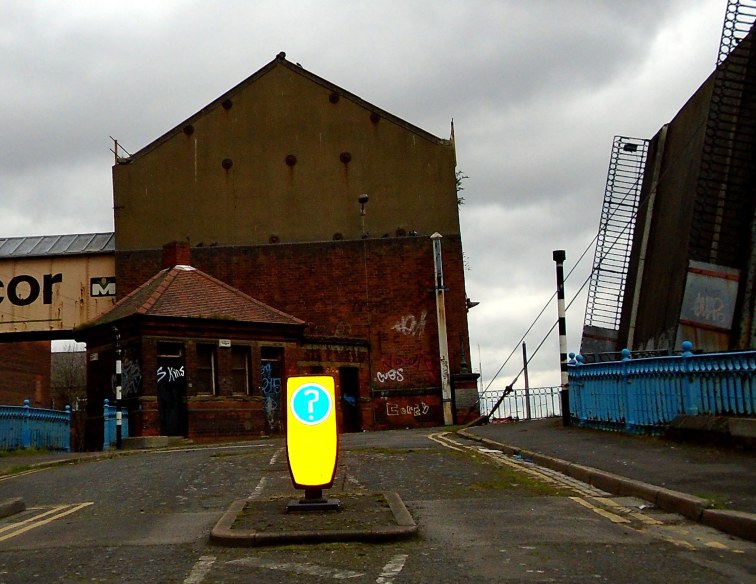
He could remember when this was a working bridge. Now it was permanently open, unrepairable they said, with the two road sections stuck in their ‘up’ positions. The one on Kev’s side still had its double yellows and central white line but was pointing at the sky like a road to nowhere. The structure was holed so he could see through to the opposite bank. Someone had graffitied on it but he couldn’t read the name. The Bridgemaster’s office was derelict and the old urinal had been demolished.
Downstream, between Grosvenor Mill on one side and Chambers & Fargus on the other, he could see North Bridge. It looked like high tide and the water was brown and sluggish. Upstream the river wasn’t so hemmed in by buildings so it was lighter and it meandered to the right to block any view of the next bridge at Chapman Street.
He looked at his watch. It was cold standing here so he might as well be in the pub. He turned his back on the river, descended the short flight of steps next to the Bridgemaster’s office, walked under the mass of the Maizecor tower and up High Flags towards the Whalebone.
On the way he thought about his grandson. He loved their walks together. He could reminisce about the kind of people who never got into the history books but who had made this the city they both loved. There was one topic which would never crop up no matter how far they wandered, something he didn’t want to share with Joe. There was only one person left he could talk to about it and he’d be meeting him very soon. He crossed the road and pushed open the door of the pub.
Inside there were ten drinkers but none of them was Roy. He bought a pint of bitter. It was hand-pumped real ale but decently priced and he took it to the empty corner table. When they had first started coming in here this had been the front room and there had been a separate public bar but the partition had been removed years ago making it all one room.
Kev liked the Whalebone. He and this pub went way back and the pub went much further back still to the days of the nearby Greenland Yards where they’d dismantled whales for money.
Like many an old pub the past was a constant reference. The walls were covered in photos of other old pubs. Many had gone now but here they were in black and white, in an inn kept going by enthusiastic publicans and loyal patrons. There was a coal fire which had been tended by Mike and a memorial to him was on his usual seat. Kev remembered him well. On the chimney breast were certificates awarded to a past landlord from his time in Gainsborough. There was a signed rugby shirt behind glass (also in black and white) and other rugby memorabilia. Where Kev was sitting there had been a juke box and they’d had a pool table squeezed in so tightly they’d had to provide a shorter cue for the restricted shots.
He remembered past landlords: Mister Grumpy who hadn’t let him use the pub phone to call a taxi (Kev could bear a grudge for years); the nice one who’d got increasingly hard of hearing; the brewer who’d made it a pub for real ale drinkers (which it still was.) He’d also introduced TV screens which Kev was less happy about but he’d seen how they could pull in the rugby fans. Only one screen (muted) was switched on now and no one was watching. Kev went to the bar to get another pint. He drank quicker on his own and the walk had made him thirsty.
It was mid-afternoon and early spring sunshine was pouring through the stained glass windows at the other end of the bar. He took his new pint back to his seat and vowed to take this one steady, at least until Roy turned up.
He and Roy were both retired and could start boozing much earlier than in the old days but rarely did so. A ‘sesh’ was a rare thing attempted on anniversaries or at Christmas. They never thought it would be like this. Back in their working lives they’d thought their drinking together would go on forever as a sort of Last of the Summer Wine in Hull.
There had been three of them back then: him, Roy and Gary. They had broken up their working week by drinking on a Wednesday or Thursday and having a regular six pints and the hangover on the firm’s time. Of the three of them only Kev was from Hull but they all liked the city and its pubs.
Well, most of them. There were some grand pubs in the Old Town but most city centre pubs were not to their taste being cavernous, noisy and purveyors of Stones Bitter. They tended to like pubs on the fringes of the centre; the pubs of New Town and the twilight zone; the sort of pubs visited by Pub Spy in the free paper; pubs selling mild with sets of dominoes and ancient crib boards for pegging scores. Unfortunately, these were the first pubs to be closed, demolished or hideously revamped. They had lost some good ones over the years.
But some had remained more or less the same. The St. John’s hadn’t changed much and that was where the three of them had started drinking. In those early days they’d stick to the one pub; find themselves a corner and settle down for a ‘sesh’. When Roy got a flat on Park Street they’d switched to the Providence establishing a pattern of Pool, chat and dominoes. They’d liked the Provy when Jack had it but when he and his wife moved on and a conservatory-type extension stuck on the side they lost interest and began a series of pub crawls.
A route would hold for a while before closures forced modifications or abandonment. Their first real route had commenced at the Minerva down by the pier. They’d played Pool in a room with a painted panorama of an 18th century harbour full of sailing ships. Kev couldn’t help wondering what had happened to that after the big refit. The landlady, Dot, had been so fierce even the Humber pilots who drank there were scared of her. Then they’d proceed to the Humber Dock Tavern with the green bricks after which it was later renamed. This was when it was a disused dock with cobbled streets inlaid with railway tracks and the rows of banana sheds; all before the development of the Marina and the bars catering to new and inexperienced drinkers. They would probably go on to the King Billy. He remembered when ‘Flash’ Flanagan had it. He’d once taken on ‘Flash’ at Pool: Elvis was on the jukebox (Elvis was always on the jukebox) and his break had been the only shot he’d taken. ‘Flash’ had lived up to his name and cleared the table. The King Billy had been extended or ‘ruined’ but the Blue Bell further along was still very much the same. Sadly the upstairs where the famous folk club had met was now a Pool room. They might have a drink in one of the historic Old Town pubs: the Black Boy, Ye Olde White Harte or the George before heading towards the last bus or the walk home. If they wanted to end the evening with something a little out of the ordinary there was the Talbot, the Royal William or the old Clarence. The Earl de Grey was always interesting. So much so that the hotel across the road was reputed to have a sign in Reception warning people against it. That should have piqued the interest of any decent visitor, thought Kev, and perfect for the City of Culture. Pity it was boarded up, the parrots were dead and the businesswomen had moved on.
He looked at his watch. Roy was now a quarter of an hour late. Kev did not worry that Roy had forgotten or seethe with annoyance at his unpunctuality. Roy’s wife had what they nowadays called ‘issues’ and she couldn’t really be left alone. Roy had probably persuaded a neighbour to sit with Alice while he went down the pub to meet his appointment. Kev had no one at home anymore. He took another pull on his pint (steady, Kev, steady now) and continued his reminiscences.
Another decade and another route: Beverley Road. They’d started at the Trades and Labour Club where the officious bloke on the door had asked every week to see their union cards. Then on to the Swan, the Park, the Bull and the Rose. In all his years drinking the latter was the only pub where he’d seen some ‘trouble’. The landlady (good cop) and landlord (bad cop) were very good at stopping things getting out of hand but heads had been cracked in here. It was still a good pub to end up and play doms even if they had to discourage someone from ‘making up a forth’. Judging by their pale faces too many patrons had been honing their indoor game skills behind locked doors. Of the pubs on this crawl only the Bull was still a pub; the kind of place where serious drinkers could drink frivolously.
For a while Drypool and Witham held sway. The pubs here had once served a dock; since that closed they maintained a precarious existence. The Waterloo had gone but the Duke of Edinburgh, Victoria Dock Tavern and the Victoria were clinging on. A short walk used to take them to the Red Lion, the Blacksmiths and the Kingston. Then onto Witham for the Windmill and the music quiz.
But the longest lasting route that they were partly honouring today (when Roy turned up) was around Wincolmlee where they’d finish up in the Bay Horse and the Whalebone. Kev remembered magical nights back in the day playing doms in the Oak Vaults while M G Greaves and the Lonesome Too played beautiful country rock on the small stage in front of them. Boats still travelled on the tide up the river Hull under Scott Street Bridge and their crews would always wave back. It all seemed so long ago. The Oak Vaults had limited opening and it wasn’t only old pubs that disappeared.
Kev looked at his watch again. This would be a record even for Roy. He found himself taking another drink. His reminiscences now took an all too familiar path: the thing with Gary.
And here was the thing: Gary had disappeared. He had vanished without trace and this had happened on one of their pub crawls.
The facts (as he knew them) were these: he, Roy and Gary were on their Wincolmlee pub crawl. It was July 1996. They’d started with six games of Pool in the Lockwoods, supped in the Oak Vaults, moved on to the Bay Horse for some Bateman’s and left there for the short walk to the Whalebone. As they stopped to admire the view from Scott Street Bridge Gary realised he had left his glasses case in the Bay Horse. He’d gone back to get it urging the pair to carry on without him and ‘get one in’. It was Kev’s round and he’d done just that. He’d bought three pints but Gary didn’t turn up to claim his.
Kev and Roy drank their pints. They drank Gary’s. They retraced their steps to the Bay Horse and made enquiries of the landlord. Gary had indeed returned to the pub and picked up his glasses case and left. He hadn’t been inside longer than two minutes. The landlord let them use the pub phone to ring Gary’s wife. He wasn’t there. The two friends stood in the bar of the Bay Horse looking at each other. He must have suddenly decided to go home and was still on his way there. Puzzled (there had been no sign he was about to do that) and slightly worried, they abandoned their night out. The following morning they each phoned Gary’s wife. He still hadn’t returned. She had already contacted the police.
From the moment Gary closed the door of the Bay Horse behind him he was never seen again.
Every possible explanation was tried on for size but none seemed to fit. Once Gary was officially a ‘missing person’ Humberside Police had really put the effort in. Kev couldn’t fault them on their investigation. He and Roy had been interviewed as had local landlords. They’d talked to Gary’s other friends and family and work colleagues. They had put up posters and asked for witnesses. They’d done door to doors. Frogmen searched the river. Volunteers (including Roy and Kev) had searched the remaining wastelands and woodlands of the city. They had even let the dogs out. They looked into Gary’s finances but he had no money worries beyond the usual mortgage. The bank card he’d had in his pocket when he disappeared was never used for subsequent withdrawals. None of his clothes or possessions was missing from the house. Nobody thought he was depressed. As far as anyone knew he had no ‘other woman’. Enquiries at air and sea ports and Eurostar all drew blanks. No note turned up and no explanatory letter was ever received. No body was ever discovered.
Gary’s wife, Tracey, had lost it big time. She couldn’t understand it and seethed with anger. Anything made her fly into a rage. A routine question about the possibility of Gary having an affair was a direct attack on her and her marriage. Any suggestion of Gary’s depression implied she couldn’t keep him happy. Of course Gary had no enemies. Did she look the kind of woman who would marry a man who had enemies? Something, Tracey would scream, must have happened to him. There was no way he would voluntarily leave all this and her sweeping arm would take in the well-furnished, tidy room and the family photographs of happy, smiling kids. They weren’t smiling any more and it was Tracey who had to deal with that.
Tracey wanted answers and none were forthcoming. For a while she was antagonistic towards Kev and Roy. Weren’t they supposed to be looking after him? In her darkest days when she wondered if Gary did keep secrets from her she suspected they knew something she didn’t: he must have said something on those Wednesday nights. It took her months to accept they knew as little as she.
When all the excitement of the investigation fell away and Tracey’s anger had turned to avoidance Kev had time to miss his old friend. He composed a list of all the things he would miss about him. Was this grief? To begin with it had all the selfishness of grief but the uncertainty of what happened made the thought of actual grief swim out of focus. Was Gary still about? Was he sunbathing on an exotic beach with no thought of the view from Scott Street Bridge? Kev had read murder mysteries and knew the satisfaction of a solution (even if he hadn’t reached it before the sleuth) but here there was none. Was it even a murder mystery or a mystery mystery? In (as they say) his heart of hearts Kev feared it was. Gary had been his usual self on the night he’d disappeared. All the signs pointed to some horrible and random violence taking away his friend. This is why he couldn’t share any of this with Joe. It contradicted his version of Hull as a good natured city and revealed the frightening truth that sometimes profound change could happen between pubs.
In the short term the search for some kind of explanation had brought him and Roy closer together. For a while they were both under suspicion by the police (and Tracey) with their mutually supporting alibis. When that had blown over they would discuss the case between them over a few pints. But it became the only thing they could talk about. The mystery hung over them. Normal conversation between them became unsustainable. How could they talk about future plans when their mate had disappeared on a pub crawl? Small talk became impossible and an obvious evasion. That left big talk and that led nowhere. They saw less and less of each other. Roy’s wife became housebound. Kev’s wife died. They rarely met up now: usually only at Christmas and the anniversary of the thing with Gary. But now (out of the blue) Roy had rung him and set this up.
And here, at last, he was. Roy came into the pub through the back entrance on Lincoln Street. When he saw Kev he did an elaborate shrug and put on a sorry face. He pointed at the hand pumps and changed his expression to signify a question.
“You’re two behind already,” Kev passed him a rapidly drained glass. “Ee Bah Gum, please.”
“I know, I know but something rather odd happened on the way here.”
“Oh, yes?” From his tone of voice Kev knew this wasn’t going to be one of Roy’s usual domestic emergency type excuses.
“Yes, something very unusual was going on in town. City of Culture performance art or something. You know: taking theatre to the streets.”
“I wish they wouldn’t do that. What was it?”
“Hordes of schoolchildren in Queen Victoria Square, milling about, setting each other off, screaming blue murder.”
“Anything to do with that Francis Bacon exhibition they’ve got in the Ferens of the Screaming Popes?”
I dunno. They’ve only got five Popes screaming and there were scores of these little buggers. Teachers were flapping around and I watched for a bit till they quietened them down. Was it mass hysteria or conceptual art? You tell me.”
Nobody in the Whalebone was going to answer Roy’s question. He paid for the drinks and took a glug of his pint. Kev looked steadily at his friend who, he had good cause to remember, had been a classic wind-up merchant. But then one of the other drinkers standing at the bar spoke up:
“Aye, I saw some blokes yesterday wandering around the Prospect Centre. There was a group of them in red robes and suchlike. They were all chanting, like.”
“Chanting?”
“Some mumbo-jumbo and one of them was banging a drum. They looked a bit lost to me and attracting a lot of queer looks from the shoppers.”
“They sound like Tibetan monks,” said the captain of the pub quiz team nicknamed ‘The Professor.’
“They’d have to be lost if they were in the Prospect Centre,” said the barmaid participating in what was now a whole pub conversation. She got a few laughs.
Roy brought the drinks over to Kev’s table.
“A rum do,” he said sitting down. Then a ritual of their own: “Gary,” he said and they clinked glasses.
“Gary,” echoed Kev. Many times over the years Kev had found himself thinking: Gary would have loved this and Gary would certainly have enjoyed Hull being the City of Culture and attracting all these odd bods doing weird stuff in the streets. But it was as if their improvisations had come to an end and they had to return to the old familiar script. This called for one of them to say something on the lines of ‘twenty (or whatever) years to the day and we have no more idea what happened to him than the night he vanished.’ But this wasn’t the usual anniversary or Christmas drink. So Kev went off-script and eschewing phatic conversation came straight to the point:
“Lovely to see you Roy, but any special reason for this drink?”
Roy put on one of those I-know-something-you-don’t expressions which, although apt in the circumstances, always managed to annoy whoever he was talking to.
“I got a call from Tracey,” Roy said leaving the statement hanging in a successful attempt at intrigue. Kev certainly found this interesting. He knew both he and Roy always sent Tracey a Christmas card and never got one back. It was if they were dead to her but here she was ringing up Roy. He had to do what was expected of him. He raised his pint glass nearly to his lips and looked over the rim with his eyebrows raised.
“Oh, yes?”
“Yes. She told me the police had been in touch with her. Something had turned up. After all these years.”
Roy paused and took a drink himself. He was enjoying watching Kev struggling to restrain his mounting excitement.
“Oh, yes?” Kev kept his voice flat. He was outwardly calm. He was not going to shout and grab Roy’s lapels.
“It…” and another highly charged pause, “was handed in to the police. It had an address on it and it rang bells with the desk sergeant. A detective passed it on to Tracey. She identified it but didn’t want it. She has, apparently, ‘moved on’. I called round and she gave it to me and I am giving it to you.” He put his hand inside his coat and slowly, like a conjuror doing a reveal, he pulled something out of an inner pocket and placed it on the table.
Kev stared at it: a turquoise glasses case.
“Open it,” said Roy.
Kev snapped open the case. Inside were Gary’s glasses, Gary’s address taped to the inside of the lid, a rectangle of yellow cloth with saw tooth edges and an optician’s label.
Kev looked at Roy.
“Where was it found?”
Roy looked at Kev.
“East Hull.”
Three chords crashed into their conversation. The barmaid had turned the TV volume back on during (bizarrely) a church organ recital. Mouthing the word ‘sorry’ she switched it back to mute and found some sports.
“East Hull? Whereabouts?”
“Hedon Road Cemetery. Do you know it?”
Kev nodded. He’d been there a few times and Joe had talked about it as if he’d been the first to discover this picturesque necropolis.
The large burial ground, sandwiched between Hull Prison and what had been the Maternity Hospital, was also home to the old Crematorium. This singular building had been one of the first (if not the first) municipal crematoria in England and within its grounds were the strange grottoes of plaques and urns placed to commemorate and hold the ashes of the dead.
“What on earth was it doing there?”
Roy shrugged. “Well that’s the question. And why should it turn up now about twenty years after his disappearance?”
They could come up with no answers to these questions. They really tried but the script had been given a serious rewrite. As far as they knew there was no connection between Gary and the cemetery. The glasses case wasn’t a clue as such but another puzzle. Its return led nowhere. Their conversation went round and round in circles and during it Kev found himself wondering how far it was true that Tracey had ‘moved on’. In their discussions it was clear that he and Roy hadn’t escaped the past so easily.
At their corner table in the Whalebone the real ale kept coming and imperceptibly Kev and Roy’s drink became a ‘sesh.’ Kev was pleased for his old friend who got out to the pub so rarely now. Teatime approached and the Whalebone was filling up. Like a proper pub, Kev thought and, again, Gary would have loved this.
The two men’s conversation turned to crime.
“Had he seen something, maybes gang-related, between the Bay Horse and the Whalebone? So that he had to be silenced?”
“But this must be the quietest part of town.”
“Exactly.”
There were criminal gangs operating in Hull in the 1990s. Only two years before Gary’s disappearance there had been an infamous murder that was said to involve gangs (no names, no pack drill). There were protection rackets and the kind of smuggling associated with every port. Rolling tobacco from the docks could be bought dirt cheap in almost every pub in Hull (it rolled on, it rolled off) and drugs were flooding in from across the North Sea. The area around Wincolmlee was full of warehouses and old industrial buildings to rent cheaply. These could easily be converted into hydroponic cannabis farms. The Hull Daily Mail was full of stories of these being busted. But had that been going on in the 1990s? Had Gary, on his way to the Whalebone stumbled upon a drug mule train, the trusty pack animals driven in single file, their backs burdened by dried marijuana plants? Kev and Roy somehow doubted it.
Ruling out such implausabilities and unable to find a money motive the two men had to fall back on the famously fickle finger of fate. Gary had been in the wrong place at the wrong time. He had slipped, completely unnoticed, into the wrong genre. And so have we.
True Crime
It was Kev’s fault that his grandson and the others got into crime. Only a couple of weeks after his drink with Roy, Joe and his grandad were out walking again and they were on Queens Road.
“See that house, Joe, next to the launderette?”
“Yes.”
“Used to be a little shop. Sweet shop I remember it as but it probably sold fags as well. Sweets in big jars. You could get any sweet in there. He had a funny manner the bloke who ran it.” He put a wheedling voice: “Thank you, chief. Very good, sir. Yes, boss; do call again, signor.” And in his normal voice: “He used to talk like that. Now here’s the St. John’s – a proper pub. They used to have a lovely old lady behind the bar. Enid was it? When she called time,” and in a pantomime dame voice: “Haven’t you lot got homes to go to?” And in his normal voice: “These hardened drinkers would down their pints and shuffle out. The main bar used to be men only. Imagine that.”
Joe could not imagine that.
“Used to be a sweet shop over in East Hull called Salvatore’s. Italian bloke ran it.” This time Joe’s grandad adopted a stage Italian accent complete with exaggerated hand gestures. “If you-a want-a Curly Wurly, you gotta ask-a for a Curly Wurly.” He chuckled to himself. Joe put on a slight smile but was secretly glad comedy had moved on since his grandfather’s day.
They passed St. Vincent’s, the Queen’s and a row of terraced houses before turning right onto Newland Avenue.
“All the bars they have down here now. This one used to be my dentist’s. That one over there was Pool’s Corner. Before that Les Turner’s shop. On that corner: Fat Larry’s. Nice bloke. He used to sell records, CDs, DVDs and Merc clothing for Mods and Skinheads. Packed it in but he should have hung around for the revival.” He looked at his grandson. “I must say, Joe, a haircut like that really is showing your balls in Hammond’s window.”
Praise indeed, thought Joe, trying not to show how proud he was of his number one.
They continued up Newland and under the railway bridge.
“Philip Larkin wouldn’t have been seen dead in there,” Joe’s grandad opined as they passed by Larkin’s Bar. “But I hear they do a good carvery. Lots of good craft beers on sale so they stick a quid on the price.”
On the corner of De Grey Street they paused. The old man pointed at the oldest building around.
“Newland Primary. My old school. Good. Don’t know why they closed it and look at it now. That bar there, Tofts, used to be a furniture shop. This one, the Lodge, was frozen foods and before that…. And this was my old street. Gone down since we used to live here.”
They walked down De Grey Street towards Bev. Road passing the famous Adelphi Club necessitating a resume of some of the artists he had seen there, none of which Joe had heard of. They stopped outside number 23, one of the bigger of the terraced houses with an attic window in the gable.
“Our old house. Backed onto the railway line.”
“Posh house, grandad.”
“Aye, Dad had done alright. He bought this in the early 70s cheap. A lot of the other houses were let to students so it was a bit noisy but I liked living here. Over there was a small shop. Mrs. Key’s. She had a son Trevor. We were friends. Lost touch though. He went to London and became a photographer. A good one at that. Did some record covers. His most famous one was Tubular Bells. Heard of it?”
Record covers? Tubular Bells? Joe shook his head.
“Ah well. Real nice bloke. Died young.”
They walked on to Beverley Road and turned right towards home.
“Your mam tells me you’ve got your sen a girlfriend?”
“Yes, grandad.”
“From down South.”
“London, aye. She’s a skingirl. She’s the one who started this revival. There are five of us Skins now.”
“I don’t like the idea of you being in a gang, Joe.”
“It’s not a gang, grandad, just a group of friends.”
But by definition they were a gang. They had a uniform and when all five of them were together walking down the street or sitting on a park bench they had an attitude and were somewhat intimidating. The three boys had their shaven heads and Sasha had the skingirl cut. The latest recruit, Fliss, still had her long fair hair but had wholeheartedly adopted the couture of Messrs Perry and Sherman and the good doctor Marten. All five teenagers wore bovver boots and braces. Oh, they were a gang all right.
“Hmmm,” said Joe’s grandad doubtfully before changing the subject as they walked under the railway line. “Someone once painted on that bridge: ‘if we can lift it, we’ll shift it.’ Good job that’s gone, a poor welcome that would be to our guests for the City of Culture. On Park Street someone painted on a wall in big letters: ‘who killed Jenny the cat in a flat near here?’ or somesuchlike. Hardly a good advert for the place. Back there in an alley off De Grey Street it used to say ‘Rizla Skins roll OK’ instead of ‘rule OK’. Get it? Rizla made fag papers. That’s an old one, Joe, for you and your friends.”
And so it was from his unwitting grandfather that Joe got the idea that was to be the gang’s contribution to the City of Culture.
Joe tried the idea out on Sasha first. He was around her house watching her splash diluted bleach onto a brand new denim jacket.
“Why should the City of Culture thing be decided by some committee? We should do something for it ourselves and graffiti could be our culture: Hull Skins Rule OK!”
“Yes, but if we paint that then everyone will know it was us. It’s still illegal you know.”
“We paint on unloved bits of wall. There are plenty of them about; just walk down any tenfoot. Everyone makes such a fuss of that ‘Dead Bod’ graffiti, making a cartoon of it and it’s even been put in an art gallery. We can do better than that: something of merit. That Banksy bloke gets away with it.”
“Interesting,” said Sasha. “Let me think about it.”
A week later and the gang are out for a curry. They had chosen Ray’s Place on Prinny Ave; something of a Hull institution and at six o’clock they were hanging about on the Avenue waiting for the doors to open. They filed in and were shown to the bar area at the back to peruse their menus. They ordered soft drinks and chose curries of varying strengths before being shown to the round table in the window. They had all rolled up their jeans and polished their boots. Jackets were on the backs of their chairs. Under their braces they wore their best shirts.
The friendly waiter brought them a pile of poppadoms and a tray of pickles. Blonde Fliss cracked one and dipped a piece into the selection she’d spooned onto her plate. She hadn’t been in the group long. She’d grown tired of being alone and had started talking to Sasha who was friendly and interesting. Other solitary types in her year seemed to be pairing up or in groups that gave them a sense of belonging. She had got that from her own family but relations there had become strained of late. (Why did they insist on treating her as a little girl?) She rather fancied Jake Lupasco who had dumped Sasha who was now going out with Joe. It was one thing to be quiet and pale but quite another to be thought pale and uninteresting. She needed a new image. She had managed to convince her parents to cough up for the outfit but wasn’t prepared for the haircut yet. It would be far too severe for her face and colouring.
The other new member was Marc Holdstock who had been accepted into the gang only a week before Fliss. He was a mate of Jake’s. Sasha and Joe felt they could hardly refuse him even though they didn’t know him very well. It turned out he was good company and he’d liked the graffiti idea so much he’d done five minutes internet research. This he was willing to share between crunches.
“It’s all done with stencils. We cut them out of cardboard, arrive at the wall, stick them on it and spray them with paint. Then we take them down and we’re off. Bish, bash, bosh. We’re in, we’re out; like commandos, like urban guerrillas.”
“Sounds good, Marc,” said his mate Jake and the other three nodded. “And you could use the same cut-out to make lots of the same picture all over town. Yesss.” To indicate that he’d topped his friend’s idea he did that annoying gesture where he’d mime licking his index finger and use it to ‘put up’ an invisible score in the air.
“So what do we actually paint?”
“Something particular to Hull.”
“The Tigers?” Jake and Marc did a high-five over the table.
“But done in a Manga style.”
“Like Manga superheroes.” Joe and Sasha did a high-five.
“Us,” said Fliss simply. “The Hull Skins.”
At this point the main courses arrived: five curries, five dishes of pilau rice and one huge naan. The artistic project meeting was put on hold for some enthusiastic eating. It resumed when everything had been consumed and the plates removed.
“Hull Skins, Fliss?” asked Sasha.
In response Fliss dug out a piece of paper from the pocket of her bomber jacket and unfolded it on the table. It showed five skins: two girls (one blonde and one dark) and three boys. They all wore white shirts with their sleeves short or rolled up, blue jeans, boots and red braces. Faces and arms were flesh-toned. Underneath in blue was the slogan: Hull Skins Rule OK! The faces were not representations of the gang but scowling, angry skinhead faces. All ten fists were clenched by their sides. A speech bubble came from the mouth of the blonde girl. It simply read: “Oi!”
“Good work, Fliss,” said Sasha and the others added their support non-verbally.
“How big?” asked Jake.
“It’s up to us. As Marc said it’s done with stencils so you cut them to the size you want.”
Marc looked pleased with the acknowledgement. His five minutes on the internet had paid off even if Fliss had done so much more by actually creating a design.
“How do we do the colours?”
“After the outline is done we use overlying stencils to block in different colours. One thing I did read online was that the fumes from the aerosols are really bad for you. We’ll need those respirator masks.”
“And overalls,” said Joe, ever practical. “We could then do it in the daytime. We’d look like we were supposed to be doing it.” Joe’s suggestion was received with smiles and nods. There was a general feeling of a plan coming together. The only sour note came from the designer herself:
“I had a worry when I was doing this. Do you think it’s a bit too, well, aggressive?”
“We rule, OK? We are aggro,” said Jake hooking his thumbs behind his braces.
But Fliss had asked a pertinent question which Jake’s bluster only highlighted. They didn’t rule and they hated aggro. They might look like a gang of young thugs, retro-styled for violence but nothing could have been further from the truth. If they came up against a bunch of real hard cases they would have to run a mile. None of them had the slightest inclination to put the boot in.
Another worry was that they might be associated with the racist skinheads on the far right. That wouldn’t do at all. Here in Ray’s they were extra polite to the waiters. They had to hope that people knew enough about the musical tastes of the original skinheads to perceive them as champions of multiculturalism. All of them had, at some time, had to defend themselves to parents, teachers and kids at school but wasn’t that the point of being different?
For the moment Jake’s answer to Fliss was allowed to stand. The dissonance between their image and their natures was not a subject worth discussing. They wouldn’t be the first or the last school kids to practice scowling in the bathroom mirror while shouting “Oi!” (“What’s that dear?” “Nothing Mum, just a cough.”)
It was sort of agreed that Fliss would produce the stencils and the others would buy the paint. This proved more difficult than they’d thought. They soon found it was illegal to sell these artistic materials to anyone under 16. A parent was persuaded to make the purchase in the Motorist’s shop while the gang hung around on the pavement like kids outside a liquor store in an American teen comedy.
A week after the curry they were ready for their first act of cultural vandalism. Fliss had made the stencils so that the figures were about a metre tall. Jake had scouted out a good stretch of wall and so on a Tuesday evening they all trekked out to the Avenues area of West Hull. For their first artistic endeavour they hadn’t yet invested in overalls or proper respirators. Instead they wore their oldest clothes and had come prepared with those thin cheap masks that decorators use. Jake and Joe carried the bags containing the aerosols. These had been swathed in rags to stop them clinking in a suspicious manner. Fliss, Marc and Sasha carried the stencils, folded as to be unobtrusive.
Joe had chosen a wall on the tenfoot between Victoria and Park Avenues. The grey breezeblocks were just asking for a mural. Marc was the designated look-out in case of dog walkers or fly-tippers. There was unlikely to be anyone else about as most people parked their cars on the street and had abandoned their garages. Just as they had practised at her house Fliss taped up the outline stencil and Joe sprayed on the black paint. The stencil was taken down and the next one quickly put up. This was the blue colour for the jeans and was followed in quick succession by the other colours.
They looked at what they had done and were well pleased. It had taken only minutes and now they could walk away (don’t run). They had worked as a team; each performing their given role in the most efficient way possible. Their artwork looked good and they had done it all without anyone getting too above themselves. Fliss had done the design work but the others were free to make their own for the consideration of the rest of the gang.
Hull Skins were on their way and walls all over the City of Culture were now proclaiming the new reign. Joe knew the city better than anyone and he scouted out more suitable sites in East and West Hull: mostly in neglected tenfoots but a couple in more noticeable positions on old hoardings. They invested in proper respirators and overalls and started to paint in broad daylight. They would claim, if challenged, to be working to a council brief. Joe had even faked up a letter (with all the proper headings, civic logos and stupid slogans) which purported to give them official municipal blessing. Different designs were tried but all featured five figures with one saying “Oi!” There were manga superheroes, Hull City footballers and famous celebs. Because all were placed on obscure walls none had (so far) been whitewashed. There had been an article in the Hull Daily Mail which hadn’t been too condemning in tone and a piece in Tenfoot City full of praise for the ‘new situationists transforming our fair city.’
But then Marc saw something on the Discovery Channel about urban exploration. These blokes broke into derelict buildings for a look-see and to take photos. The men had scarves over their mouths because what they were doing was illegal. They preferred the term ‘gained access’ to ‘broke in’ but that was clearly what they were doing. They were at pains to stress their simple intention to explore these neglected buildings. “Take nothing; leave nothing” was their mantra. No souvenirs were allowed beyond the photographs which they’d post on the internet.
His interest piqued, Marc started looking at the websites dedicated to this growing pastime. Devotees liked to call their hobby urbex (or even UE) to make it sound rather cooler than it was. They would show up in their photos shyly wrapped up in scarves, balaclavas and hats. They were, as far as Marc could tell, all male.
Urban exploration had already reached the 2017 UK City of Culture. Hull had, after all, no shortage of derelict buildings. The Lordline building was a popular ‘target’ and the Clarence Flour Mill before it was demolished. Some of the photos and videos were spectacular and gave Marc an idea for further adventures for the Skins.
He had no intention of obeying the golden rule of “take nothing; leave nothing.” He saw urban exploration as an excellent way of getting their graffiti on seemingly inaccessible but highly visible places. No more skulking about on tenfoots; it was time the Skins really made their mark. He put the idea to Jake first and his approval (not unexpected) led to the proposal being put before the others.
The discussion was held in Pearson Park. It was now early May and a warm evening so they were sitting round on the grass. Marc had managed to source some Polish lager to help “get his idea across” but it just meant their voices were raised by a couple of notches. The meeting was still good natured and free discussion was encouraged even if it got (increasingly) spirited. Joe and Sasha were against the idea and were accused of sticking together; a charge that was hard to dispute. Mark and Jake were pushing for it and that left Fliss as the floating voter. Actually she was nothing of the sort. She still fancied Jake, hoping to win his approval by supporting his plan however hare-brained. By now Fliss had fully committed herself to the gang and been persuaded to let Sasha’s mum give her a skingirl haircut. She had kept some longer hair at the back of the neck which made her look more of a traditional skingirl than Sasha.
So, here she was: sitting on the grass in the park in her olive green bomber jacket, a can of lager in one hand and arguing vociferously for a daring recreational trespass with intent to commit criminal damage.
“What if we get caught?” Sasha asked the obvious question. Fliss let Marc give an equally obvious answer:
“We won’t.” It was the lager talking but English was its chosen language.
“But what if we do?”
“Trespass is a civil not a criminal offence,” said Marc who had studied the urbex websites for just this sort of telling detail.
“But if we’re carrying aerosols, stencils…”
“We dump them as we run. Look, we’re just kids, right? If we are caught (unlikely) we say sorry and we won’t do it again. We now realise how silly we’ve been. One of us could have got hurt in there. Please don’t tell my mummy, mister.” The last was delivered in the sort of wheedling voice that youngsters fondly imagine is irresistible to authority figures.
“Let’s at least try it,” said Fliss taking a slug of her lager (how strong was this stuff?)
Outvoted and for the sake of the gang Sasha and Joe agreed to Marc’s criminal scheme. They had only to decide which derelict building they would explore. Urban decay in recent decades had provided a host of possible sites for urban exploration. Unfortunately some had been demolished as part of a tidy-up operation before 2017. As well as the Clarence Mill the New York Hotel and the neighbouring Fair and Square Club had gone. (In itself the pulling down of the latter, Hull’s Albert Hall, had been an act of official cultural vandalism.) But the gang had its own old-school urban explorer.
“There’s a disused factory I know…” said Joe.
A few nights later and the gang were on the streets of Hull’s twilight zone. Some industrial and commercial activity still went on here but most of the factories and warehouses had been abandoned. At six-thirty in the evening these streets were deserted. This was just as well for although their hoodies and caps made them look like any group of Hull teenagers, their bags (containing the overalls, masks, paints, stencils and torches) and their assumed nonchalance (was Marc actually whistling?) made them look deeply suspicious. It would have been a serious dereliction of duty if a police patrol car had driven by them without stopping.
Joe’s disused factory was near the river but upstream from Scott Street Bridge. Most of it was single storied and looked interwar but an extension had been added sometime to create two storeys and, Joe noted, this part had a flat roof with a door leading inside and giving access to a stretch of blank wall. Missing slates and broken windows signified the building had been abandoned. The factory had a large yard with a platform and loading and unloading bays. It was fenced off from the road and the main gate had a sturdy no-nonsense padlock. Wire fence and gate were covered in notices telling all-comers that the property was protected by a security firm. There was a telephone number that promised an instant response if anything untoward was reported and such vigilance would be rewarded. Indeed, be assured: Protectotech was the firm that never slept.
Joe had already scouted out a possible means of access. There was a two-foot wide section of fence with no razor wire coiled about its top. It was handily next to a corner of the factory wall. Looking around and finding the street empty Marc gave Jake a leg up. Steadying himself by one hand on the wall, Jake climbed over and jumped down into the yard. One by one the others followed his lead. Marc threw the bags over the fence for them to catch and ran at the fence and scrambled over without help. The others mimed applause.
Clutching their bags they reconnoitred the yard. The doors and windows had been boarded up and stickered with more Protectotech warnings. Disregarding these, the intruders searched for a weak spot in the factory’s defences. It was Sasha who found it: one of the boards was loose and could be easily prised away to allow them to squeeze through.
This wasn’t just a lucky break. To judge by the graffiti inside, the building had been entered many times before. That was the beauty of the Skin’s approach: they weren’t pioneers and didn’t need a ‘virgin’ site. It was much easier if boards had been loosened or wire cut by real urbexers.
They had entered through one of the loading or unloading doors and were now standing in a large space. Some light filtered in to reveal some internal walls and a sea of debris but if they wanted to pick their way through this and avoid accidents they would need their torches. They dug these out as well as their masks. The smell was potentially nauseous.
Five torch beams swung around the space seemingly at random, picking out odd details: unremarkable graffiti, old health and safety notices and toppled workbenches. The floor was covered in litter left by previous visitors or the long-gone workforce. Despite their bovver boots none of our Skins wanted to disturb the filthy rags or piles of paper for fear of what might live beneath.
“What did they make in here?” asked Fliss.
“It was a bottling plant,” said Joe who had asked in grandad in his best butter-wouldn’t-melt-in-his-mouth voice.
“Never mind that, let’s find a way upstairs,” Jake said, moving off with his torch finding him a route. The others followed his lead in single file.
The dereliction had an unexpected effect on them. Instead of being excited and running about exploring, they all felt quite sombre. Maybe it was the litter and the smell. Perhaps it was the poignancy of an abandoned workplace. Workers had shouted to each other over the noise of the machines. Bottles had rattled along production lines. Now there was only an eerie silence. None of the gang felt like speaking. They wanted to do what they had come to do and get out.
Through a doorway they found a staircase which looked solid enough to support their weight. Jake, again, took the lead in bounding up it. They were now in one of the more recent extensions to the factory which had been divided up into storerooms and offices. The windows up here were not boarded over and they switched off their torches. Many of the panes of glass had been broken by kids throwing stones. Their missiles were lying all over the floor.
They bunched together so Fliss could take a selfie of them all but they still didn’t feel at ease. Fliss was noticeably nervous and kept twisting one of her side locks of hair around her finger. Marc had done all his urban exploration on the Internet and the real thing was something rather different and much spookier than he’d imagined. Sasha remembered Jake’s line about them being just kids. Perhaps they were and just searching for bigger and better adventure playgrounds. If so, she didn’t like this one. She and Joe had said this was a bad idea but no one had listened. Joe himself was thinking about something his grandfather had said: how back in the day each town had its own local producers of soft drinks with proper lemonade, proper orangeade, and proper limeade; before everything was American. Jake was the least worried by the atmosphere. He strode through the first doorway looking for the way onto the flat roof. From the moment he’d got over the fence so successfully he’d felt confident enough to lead the expedition.
The next room was laid out as a classroom with tables and chairs laid out in a U shape facing a whiteboard. On this a diagram drawn in red and blue marker pens could still be faintly discerned as a ghostly reminder of an ancient training session. Three triangles enclosing circles pointed towards a common focus. Perhaps it was the management structure of the defunct company or a flow chart or a simple schematic. (We would recognise this sign and so would Sasha and Joe if they’d looked more carefully.) The teenagers didn’t glance at it; they’d learnt at school how to ignore whiteboards.
Access to the flat roof was through a door marked ‘Emergency Exit’. Jake pushed the bar down and shouldered the door until it opened. They trooped out of the training room and onto the flat roof. They were only on the first floor but got a decent view of their surroundings. The blank wall they had come to paint would be seen from several streets away. There were no railings at the edge of the roof but the handrails of an old fire escape were now visible. Jake leaned over the edge to have a look at it.
“Bottom half’s missing. Let’s get to it.” So saying Jake unzipped his bag and stepped into his coveralls. The others took his lead. In their paper suits, caps and respirators they were totally unisex and anonymous. Nevertheless it was still light and they felt terribly exposed up here on the roof as they took their turns with the stencils and the paints.
Marc’s design for their first shout-it-from-the-rooftops piece of street art was a departure from their usual style and featured one huge grinning face. From its gurning gob no speech bubble emerged. All their usual colours were to be deployed with the addition of some bilious day-glo lemon for the cheeks.
The work was almost complete when they all heard the distinctive rattle of a chain followed by the opening of an unoiled gate. They froze, pulses suddenly racing, and dropped everything. Together they peered over the edge of the roof. Directly below them, inside the factory yard, were five uniformed men. They wore peaked caps and carried flashlights. Outside on the street were two cars bearing the Protectotech logo. One man looked up and saw them.
“Oi!” he shouted, pointing. Four heads ducked back out of sight. Jake continued to watch as the guards raced round the loading platform and gained access to the building by means of the same loose board they’d used.
“We’re trapped here,” he said, “unless…”
“Unless what?” Fliss sounded scared.
“We use this ladder and jump the rest of the way. I’ll go first.” Without another word (or any discussion) Jake gripped the rail and swung himself over the edge of the roof and began the climb down. At the bottom he swung from the last rung and dropped the remaining five foot. He landed properly with bent knees and straightaway beckoned for the next escapee to follow him.
Fliss pushed herself forward, seizing the handrails before anyone else had a chance and lowered herself down. She jumped even before she’d reached the bottom. Jake still succeeded in catching her and gently lowered her to the ground. They stood face to face and he had to remove her shaking arms from around his neck.
Sasha followed but swung from the lowest rung as Jake had done to signify she needed no assistance. Jake was on hand to catch her if necessary but she made the jump as successfully as he. Her boots hit the concrete with a parade-ground stomp.
Awaiting their turn Joe and Marc could hear the shouting of the security men as they climbed the stairs. Marc followed Sasha but Joe had to start his descent even before Marc took his jump as a guard’s face had appeared pressed against the window of the door. Luckily Marc had had got out of the way before he had to drop down. By the time he’d straightened up the other four were already heading for the gate. Then into the opening stepped another guard, blocking their path and holding up one hand with the palm towards them.
“Now then, lads,” he had time to say before Jake, running at full pelt, barged him out of the way. The exit was clear and the five intruders were in the street. Sasha and Joe turned right while Marc, Jake and Fliss went left. At the end of that street Marc peeled off to make his way home on his own. Taking off the respirator but without removing his coveralls he ran as fast as he could to the estate. Joe and Sasha did stop to take off their kit and hide it behind some bins. Without their caps but with hoods pulled up they sauntered back and after a few twists and turns to throw off any pursuers they too arrived at Marc’s house.
Jake and Fliss didn’t have it quite so easy. They hadn’t time to remove their painting garb before a Protectotech car caught up with them and gave chase. Jake matched Fliss’s pace and they turned from Oxford Street into Swann Street. They carried straight on with the pursuit right behind them. But Swann Street was a cul-de-sac with Barmston drain at its end. The car stopped and the headlights came on to dazzle the fugitives. The driver’s door opened and the man Jake had pushed over started to get out.
“Right, sonny,” he said and any avuncular tone had gone. Jake felt for Fliss’s hand.
But Jake had been out with Joe and Sasha and he knew something the hired goon from Protectotech didn’t know: the road might be a cul-de-sac but there was a footpath on the bank of the drain. He tugged Fliss that way. At this time of year the footpath was somewhat overgrown and they were soon hidden from view of the angry shouting man. It wasn’t far before they emerged at the road crossing the drain. On the other side they could see their estate ahead but continued along the bank as far as Fountain Road. They climbed up onto the embankment and hid their overalls in the bushes. At the end of the path they scrambled down the bank into the estate. There they heard a car coming up behind them. Fliss pulled Jake towards her for a very realistic snog which continued long after the car had passed.
Marc, letting them into his house, could sense that something had changed between them but said nothing. It was a warm evening and they sat out in the small garden. Marc generously gave each of them a can of his dad’s lager. (His father was out and his fridge had given up only a fraction of its freight. Marc hoped he wouldn’t even notice.) They had two garden chairs and improvised other seats from what was lying around. When it was dark there was light from the kitchen window and open door. They were in no mood to consider the neighbours. They were loud, especially so in their tension-diffusing laughter.
“Hull Skins: five; security guards: nil,” said Jake. He had good reason to be happy with the evening’s adventure. He’d come out of it very well. He’d taken the lead in the urbexing and the escape. He’d shoulder-charged a highly-trained security officer to allow them all a getaway. He’d impressed Fliss so much that she (probably) wanted to be his girlfriend. The others were happy to praise his contributions and his self-esteem had risen accordingly.
Sasha was worried about group dynamics. Something had drawn Jake and Fliss together. They kept glancing at each other. Marc was watching them too. He looked somewhat left out. The urbexing initiative had been taken from him. Sasha, the first Skin, was feeling a bit sidelined too.
Joe was thinking about what his grandfather would say about ‘playing in gangs’ with the list of potential criminal charges lengthening by the day.
Fliss felt she had let herself down by her panic on the roof but was pleased with the sudden progress she had made with Jake (would it ever amount to anything?) She would have to be tougher next time. She was a Skingirl not a gangster’s moll.
As they talked and drank they forgot about the unease they’d felt in the old bottling plant. The whole experience was talked up until it became a heroic adventure and thrilling escape. Hull Skins had been triumphant. It was Marc who first suggested another go.
“We’ll need to replace the paints. Maybe take more care not to be spotted. Any ideas on a target?”
The gang looked to Joe.
“Well,” he said thoughtfully, his brow creased. “There is a building I’ve always found interesting. It’s much more of a challenge than the last one. It would need a real head for heights.”
“Oh, yeah?” said Jake, excited. Despite serious misgivings Fliss put on an enthusiastic face.
“The old British Extracting Company silo. You know the one by the river with a blue box on top. Big and tall with a flight of stairs up the side leading to a door. It looks completely derelict…”
 pig productions
I enjoyed the continuity of place and time in this episode with the writer’s usual attention to detail and speech. Still a sense of something terrible impending. As the reader I am watchful and intrigued. I am wondering how all these threads will at last come together. As the City of Culture perhaps it is Hull that is the glue!
LikeLiked by 1 person
Just caught up with instalments 2 to 4. I’m really enjoying the developing plot and the writing style. I’m also enjoying all the Hull references including some very familiar locations….!
LikeLiked by 1 person