
War
Heinz Hasenkamp had doubts about Brodeur’s plan (henceforward known as The Plan) but kept them to himself. The Frenchman and Demi Leather had outlined their ideas to him straight after he had passed their ridiculous spot-the-genre test. Theorist Brodeur had done most of the talking.
“Heinz,” he’d said that day in his office. “I have to be completely straight with you. The Yanks are on to us.” He’d held up one finger. “One, they found out we were in Hull during ‘Western’. Two,” and another finger joined the first. “Questions were asked in the lovely Wilmington Café.” He’d turned to Demi. “Another slip-up by Feyderbrand: that café should have been out-of-bounds right from the start. It’s too close. We drew attention to ourselves.”
Demi had nodded sympathetically. Another finger went up.
“Three,” Brodeur had continued, facing Hasenkamp again. “The police are interested in one of the men who were asking questions in the café and we don’t know why.” Brodeur raised another digit and grasped it in his other hand for emphasis. “Four, and most important, the bizarre one-woman attack in ‘Fantasy’ that took from us our beloved Chief Semiotician.”
Hasenkamp managed to keep his face straight.
“They will try again and they will come in greater numbers.” Brodeur lowered his arms.
“Depending on the current choice of genre,” qualified Demi Leather.
“Of course,” Pierre agreed. “It could choose ‘Romance’ again or ‘French Farce’ or ‘Pastoral-Comical’ or any of the gentler genres but we should be prepared for anything. Eventually they will come. We need someone out there who can give us the heads up on what’s going on in the city. You’ve proved you can successfully negotiate Hull without a dream suit. You can be our eyes and ears on the ground, so to speak. Find out as much about the Americans and their plans as you can.”
Hasenkamp had immediately spotted the flaw in The Plan. He could find out something about American intentions that could be rendered utterly useless on the next random genre change by the machine. He could forever be chasing his own tail. He kept his misgivings to himself. Being out and about in the open air was preferable to being cooped up in here, playing endless games of Canasta with the same three people. He had wondered if the top floor boffins had somehow been infected by ‘Spy’ but he had agreed to go.
And so he’d been booked into the Kingston Theatre Hotel and had a room with a view. He was overlooking Kingston Square. He had watched the crowds arriving for the re-opening of the New Theatre. He could even see Pierre Brodeur’s house.
His cover was ‘something in the media’. If questioned further he described himself as a ‘profile engineer’ working to upstart the post-2017 legacy programme across multiple social media platforms and his questioner’s eyes would have glazed over before he got to the end of the sentence. Nobody asked him what it meant.
His days fell into a pattern. After an excellent full English breakfast he would head out into the City of Culture. He might stick around the Old Town and city centre or take a bus ride to walk around the suburbs and estates. In the evening he would eat out and try a pub or bar. He might stay in his room and watch the news. He was looking out for unusual activity, particularly involving Americans. There was no shortage of this but nothing that seemed to threaten the Extractor.
During ‘Revenge Tragedy’ he had walked freely about the city and seen no outward changes. Hasenkamp guessed acts of revenge were going on all the time but not noticeably. The machine had specified (for some reason) that the Tragedy was in three acts which meant it sounded like a play and a very old-fashioned one at that. Almost like that Shakespeare or one of his mates. But on the streets of Hull there was a distinct shortage of doublet and hose.
Towards the end of September Hasenkamp was about to enjoy some autumn sun and apple scrumping in Orchard Park. He was sitting on a bench in the transport interchange waiting for a bus to take him there. His phone vibrated in his pocket and he pulled it out. He had a text message alerting him to a genre change. The message simply read: ‘War. You are recalled to base.’
Hasenkamp was in the highly dangerous genre of ‘War’ without the protection of a dream suit. The recall was tempting. He looked about him. People were queuing for buses or walking through the queues to bays further along the concourse. Even at ten in the morning the sandwich shop near his bench was doing good business.
He could see no obvious signifiers of ‘War.’ Some of the bays contained waiting buses. There were no tanks or APCs. None of the people queuing were in body armour or toting fearsome weaponry. The only camouflage clothing he could see was being worn by children or students. Olive green flight jackets were in evidence but belonged to members of a teenage skinhead gang over to his left.
But Hasenkamp was an expert on genre and he well knew that as the nature of warfare changes so must the iconography. Some of the people waiting had bags and holdalls. Some had rucksacks on their backs. Outside the bus station he could see vans and trucks.
It was possible that he was witnessing the home front. Here were people keeping calm and carrying on. Perhaps the real war narratives were developing in other theatres. But Hasenkamp didn’t think so. The Americans were on to them. This was more likely to be a ‘phoney war’ as they got their men into position before an assault on the Extractor. He texted back: ‘No recall. Send reinforcements if possible.’ He was still needed out here and maybe more than ever. Despite appearances this was wartime.
Briefing: Black Squadron; OTP – 10 (September 30th) 1900 hours.
DEVGRU Base, Virginia.
All present & correct.
Presiding officer: Chester Parmenter.
The windowless briefing room was full. First comers had chairs arranged in a semi-circle facing a large monitor screen. Others perched on desks. Even more stood. None of them looked like military men; some had beards and long hair. They wore no uniforms, identity patches or tags. But make no mistake: all these men were elite troops belonging to the Special Missions Unit of the US Navy, DEVGRU or, in popular parlance, Seal Team Six. Black Squadron was the intelligence gatherers.
Parmenter strode into the room and his men snapped to attention.
“Okay, okay,” Parmenter waved them back to their seats. He was wearing a sharp suit, collar and tie. There were no ribbons, epaulettes or insignia for him today. He had a serious face and used his mouth sparingly. But this was a briefing and info. had to be imparted.
“We’ve got a mission, men. Designation: Operation Teeth Pull. I know but I don’t come up with names. We leave that to Washington. We are to provide top quality and solid intel, recon and surveillance for Silver Squadron who are the assault team. This is the target.”
A photograph appeared on the big screen. The men leaned a little closer.
“The British Extracting Company Limited silo. Except it’s not. It hasn’t been that since the days when the Brits made things. Essentially it’s a brick box with something going on inside it. And the highest authorities in this land want to know what that is. Your orders come from so high up they were passed to me by wingéd Seraphim.”
“Sir!” barked the men in unison to show they welcomed their mission and appreciated Parmenter’s little joke.
“So, Silver Squadron are going to get inside this brick box which we are one hundred percent sure is hostile. We are going to give them all the intel they need for a successful operation.”
“Sir!”
“We fly out over the next few days. You will all have a different itinerary. Before Fashola briefs you further with our satellite, drone and pedcam footage I must stress the importance of your role in supporting our Silver colleagues. And I must warn you: this time you’re not going to some desert shithole or a steaming jungle hell. You are going to the United Kingdom and Hull, their current City of Culture. There will be temptations: art exhibitions, musical soirees, contemporary dance, apartment blocks with coloured lights and there is even a fairground. But you will remain focussed at all times. Is that understood?”
“Affirmative, Sir!”
Briefing: Institut Baudrillard management team; 1st October 10 am.
Conference room, top floor, British Extracting Co. silo.
All present & correct.
Meeting chaired by Pierre Brodeur.
Brodeur looked around at his team. They all looked shaken. The new choice of genre had spread disconsolation throughout the Institut. Demi’s eyes were downcast. Gerwine was looking worried, perhaps dreading another siege. Jean Flaneau was doodling dress designs on his notepad. Only Charles Renard didn’t look too down-hearted. Maybe, as head of security, he was privy to some of Brodeur’s thoughts that the others were not.
Pierre began the briefing: “For the duration of this genre we shall call ourselves the War Cabinet, even though,” and he held up a warning finger to forestall criticism. “I am perfectly aware that we, in here, are outside genre. But… Charles?”
The head of security took up the thread: “We will soon be at war. The Americans are bound to attack us. We’re on British soil so it’ll be covert. No bombing, no explosions. Their persistence in locating us suggests they want whatever they think we’ve got and not its destruction. They will attack us.”
“But the machine will scramble their brains. They have no genre-transformation-resistant membranes.”
“That’s right, Jean, they have no dream suits but if they break into the silo it will take some time before they are rendered incapable. It took some time for that American agent in Paris to lose it and these guys will be fully weaponised to 2017 specs. This will be a deadly assault before they are neutralised by the emanations.”
“So what do we do?” asked Demi.
Pierre Brodeur gave one of his sweetest and most persuasive smiles.
“We hide,” he said.
Briefing: Silver Squadron; OTP – 8 (October 2nd) 0800 hours.
DEVGRU Base, Virginia.
All present & correct.
Presiding officer: Dick Hays.
Hays was a formidable officer who had won the unquestioning respect of his men the hard way. They had stacked all the chairs and were expectantly before him in the stance known as ‘at ease’ which isn’t at ease at all. No one would be sketching frocks in one of his briefings.
“Men, you’ve been waiting for this mission all your lives.” None of his men exchanged glances. They all stared intently at their C.O. and tried not to blink.
Dick Hays was a veteran of river-borne ops and had made his name running snatch squads in South America. Anywhere near a river was vulnerable to Hays and his men. A target could be hooded and bagged and onboard one of the Squadron’s stealth boats before anyone knew he was missing. In this way a pinko politician or populist anti-American dictator would soon find themselves in a re-education centre. Drug cartel bosses were less lucky and usually tossed over the side.
Silver Squadron had been somewhat sidelined during the desert wars and plum ops like Neptune Spear against Bin Laden’s compound had been assigned to other squadrons. Hays was nearing the retirement age for special ops and this might be his last mission. He was desperate for a resounding success.
“Men, this may come as a surprise to some of you but there is something out there that does not belong to the U. S. of A. We don’t know what it is but we want it. It is our manifest destiny to own this thing. You are going to be the lucky ones who bring it home to Uncle Sam.”
His assistant fiddled with a laptop and the big screen sprang to life showing drone footage of the silo. The camera dipped and soared around the building.
“The thing we want is inside this old building. And lookee here, it’s only slap-bang right next to a river. A tidal river.”
For the first time some of the men in front of him changed their expressions and they were smiling.
“Black Squadron is already out there scoping the place out for us. Our job is to get inside. Now, this building isn’t behind enemy lines. It happens to be located in one of our staunchest allies and I don’t mean Leakistan. So we are going to observe the niceties, get me? We’re going to have to pretend to be the C.I.A. again.”
This got an appreciative chuckle but Hays made a chopping motion and it immediately ceased.
“Listen up. You are the best. You’ll get in. You’ll take control of the building and whatever is inside it. You will use whatever force is necessary but the personnel inside will be useful to us. And their computers and everything we can carry. Essentially, this is a fully authorised If-You-Can-Lift-It-You-Must-Shift-It operation. Do you understand?”
“Affirmative, Sir!”
Operation Teeth Pull was to take place on Tuesday October 10th. This was the week of Hull Fair and there would be noise and lights in the sky to distract any likely observers. At 2217 hours there would be a perfectly serviceable high tide of 7.23 metres at the entrance to the River Hull. The moon would be in the third quarter but cloud cover was forecast.
In the week leading up to the attack, while Silver Squadron was still at sea, Black Squadron were deployed around Hull engaged in surveillance and intel gathering.
Chester Parmenter was based in the Marina Plaza Hotel and coincidentally had the same suite as Angel had occupied back in July. It was perfectly suited to his needs. He had a good view and could keep an eye on the comings and goings in the Marina. The room was comfortable and he had an amenable hotel employee in Andrzey who would cater to his every whim. Above all, he had a comms. set-up allowing him access to DEVGRU and Ms Morales back Stateside, his team in Hull and the assault group in their submarine. Parmenter’s squadron were each billeted in different city centre and East Riding hotels. Parmenter had made sure he got the best deal.
The silo was under constant surveillance. Dressed as workmen, truckers, joggers, anglers, truants and all-day drinkers of strong lagers they circled the target 24/7 looking for any break in the silence and inactivity which characterised the huge brick edifice. They were not to draw attention to themselves. They were to keep their sidearms holstered. Those clandestiners not on silo detail were around town, blending in and ever-watchful. Their reports came to Parmenter who summarised them in the dailies for Virginia and the sub.
The date for the assault grew ever nearer.
War, they say, is ‘interminable boredom punctuated by moments of terror’ and Hasenkamp was bored. He’d explored much of Hull and the surrounding countryside. He’d been tempted with cultural offerings. He hadn’t been focussed at all times. His plea for reinforcements had been ignored. He was bored and lonely.
For old times sake he took a bus out to Cleveland Street to revisit the Wilmington Café where he was sure of a good lunch. He was in for a shock. The interior had changed beyond recognition. The log fire and the old photos had gone. There was nothing to show it had once been a railway booking office. The tables with their little flower vases had been replaced with booths. Each had an old-fashioned juke box terminal and an array of squirty sauces. The kitchen had been opened out and the counter was faced by a row of stools. Neon signs advertised American soft drinks. Instead of the blackboards there were illuminated menus. The selection had been drastically reduced to US-style breakfasts and snacks.
The café where he and Dieter had enjoyed the best French cuisine that Hull had to offer had been retro-styled into a 1950s American diner. It could have been a film set; a fake of a fake of a fake; one of Baudrillard’s simulacra. But it was doing well and the place was almost full. None of the patrons were known to him. He did recognise the owner even though she was now wearing a waitress costume. She smiled at him.
“Oh, lovely, Herr Hasenkamp. We haven’t seen you in here for ages. Do you like what we’ve done to the place?” Before he could answer (possibly the distaste showed on his face) she turned to the room. “Herr Hasenkamp used to be one of our best customers back in the days when we got so many Europeans in here from the old silo.”
All eyes were on him as Hasenkamp started to edge backwards towards the door. The new patrons of the café got to their feet. One of them pulled a gun. The moments of terror were about to begin…
When the bag was pulled off his head Hasenkamp saw he’d been brought to a hotel room. His feet and hands were bound with zip ties. Three men faced him. They were in comfortable armchairs. He was in the kind of chair hotels provide near the desk but that no one ever uses except to hang their jacket on. The room could have been anywhere. The curtains were closed and the paintings were abstracts. (He was in Parmenter’s suite in the Marina Plaza. Andrzej had turned a blind eye to the hooded guest bundled through Reception by Mr. Parmenter and his two friends.)
“Herr Hasenkamp,” one of the men said in a let’s-all-be-reasonable tone. “Tell us, please, what is in the silo?”
Hasenkamp swallowed and considered his options. He was in the war genre. He was a captive of the Americans. He wasn’t a hero. He wasn’t sure if the Geneva Convention was still in force and, anyway, he and his captors were not in uniform. He didn’t have a rank or serial number and they already knew his name. He was going to co-operate.
“A broken genre transformer,” he said. “We have a machine which can change the way people interpret signs.”
The three men looked at each other giving nothing away.
“Keep talking,” said a different man.
“Are you familiar with ideas about perception and schemata?”
“We ask the questions around here.”
Hasenkamp nodded. These knuckleheads might not be conversant with psychology or the finer points of semiotics but their grasp of the conventions of the war genre bordered on cliché; a cliché that could mean a world of pain.
“OK, well, first things first…”
We can fast forward through Hasenkamp’s rather laboured explanation of the nature of perception (nothing is real) and the priming and evolution of schemata to help us understand the world as revealed to us by our senses. Even the interrogators got tired of it.
“He’s talking so much so he doesn’t have to tell us anything.”
“Yeah, buddy, cut to the chase. How does it work?”
“I don’t know. You’d need one of the engineers or technicians. I just know about signs.”
“Try.”
“Your brain isn’t a projection room where a tiny ‘real you’ watches a film of ‘out there’ in colour, with sound and smell and taste and touch. Your brain is lots of electrical stuff going on. Well, our machine is full of electrics. Our electrics talk to your electrics. We tinker with the schemata in your brain. By changing the genre we change the codes and conventions that govern the way you interpret signs. Genres drive certain expectations in the narrative, tone, representations, costumes and so on.”
“And this machine of yours is broken?”
“Yes. We can no longer choose the genre. The machine does and at random. Do you think this war was our idea?”
In ‘War’ there is an underlying ideology: the end (victory) justifies the means. The interrogation of Hasenkamp over the next few days took many forms. All his theories, even his drawings of the inside of the silo, couldn’t help him. There was always more they wanted to know, stuff a genre theorist couldn’t possible be expected to understand. His interrogators refused to believe in invisible dream suits. His warnings fell on deaf ears. Worse: they were going to take him with them on their raid on the silo.
The night of October 10th was as dark and quiet as the planners had hoped. Clouds obscured the moon and were occasionally lit from underneath by the sweeping lasers from Hull Fair. There was no one around to see the four stealth dinghies as they cut their motors by the Deep. From then on their progress up the River Hull was almost silent. The men did not speak and their oars were muffled.
Dick Hays had his customary position at the fore of the first boat. He looked back at the deadly attack force under his command. He knew Silver Squadron wouldn’t let him down. He had supervised their induction and training personally. Little was known outside DEVGRU of the rigorous training programme. Even their pre-engagement bonding rituals were classified. (These had taken place on the sub with only one minor casualty.)
After they passed unnoticed beneath Drypool Bridge the last boat pulled into the left bank at Blaydes Staith for loading the ‘baggage.’ This was Hasenkamp who was not only hooded but gagged and bound. Hays had not wanted to bring him. He was an enemy and worse still he was an enemy civilian. He would just get in the way but Parmenter had insisted he would be useful.
The fourth boat pulled out to rejoin the others with Hasenkamp crouched miserably at the stern, his escort only inches away with knife drawn.
With the exception of their captive all the men were dressed identically. They were all in dark urban camo and bore no identifying marks. Every man wore body armour with hard-plate reinforced vests. Their combat helmets were covered in cloth but had so many mounts for NVGs, comms. gear and cameras that the helmet itself was barely visible.
The four-tube Panoramic Night Vision Goggles and the respirators gave the soldiers of Silver Squadron the look of alien invaders.
Each man carried an assault rifle. This squadron’s weapon of choice was a Heckler and Koch 416 carbine fitted with racks for a variety of aiming devices and even grenade launchers.
The flotilla passed under North Bridge without being noticed. It was a Tuesday night and this part of town had few pedestrians. The Casino wouldn’t get busy until later and Wincolmlee was deserted.
They reached Scott Street Bridge. No one was standing admiring the view on this night. As they rowed past one of the dinghies scraped against a wooden pier. Hays scowled back towards the boat responsible but no one could read his expression beneath the respirator and he didn’t want to use his mic. They were to maintain radio silence as long as possible.
The river went into a meander. Halfway along it they passed under Sculcoates Bridge (again deserted). After the waste treatment plant the river bent round to the left again.
They approached Wilmington Railway Bridge and their target was in sight. Hays could almost feel a wave of anticipation ripple through the squadron.
The silo had a sort of quay under the overhanging structure known as its receiving house. They moored there and there was the occasional squeak of rubber when the dinghies scraped against each other. Even at high tide the quay was above their heads and ladders were rested against the wall. Silently the men climbed up to stand in the shadows of the silo.
Hasenkamp could not climb. He was still hooded and bound and he had been weakened by the interrogation. He had to be helped up to stand shivering with the assaulters. There was a door here, not the main entrance, but it would allow them into the silo and he alone fully knew what that would mean.
Hays was impatient to get inside. Getting the civilian up here had wasted precious time. He gestured for the attack to begin. The ram swung and the door crashed open. The shock troops ran inside. The interior of the silo was in total darkness but that wasn’t a problem for the soldiers with their Night Vision Goggles. They’d been prepared for the strange nature of the silo’s internal space by Hasenkamp’s sketches and they spread out to surround the huge metal construct at its centre.
“Ground floor secure,” said the voice in everyone’s headset and the rest of the men charged in. One man was left to guard the door. Hasenkamp was dragged roughly inside by his escort. His hood was removed but this meant nothing to him until some NVGs were pulled over his eyes. These weren’t the ultra hi-tech GPNVGs worn by the assaulters but he could see in the dark even if he had to keep swivelling his head for a wider field of vision.
The goggles made everything green and murky. The operation was conducted in near silence. The effect was disconcerting. Perhaps, Haseenkamp couldn’t help thinking, pond life was like this. The assaulters in their body armour, helmets, respirators and four-tube goggles did not look human.
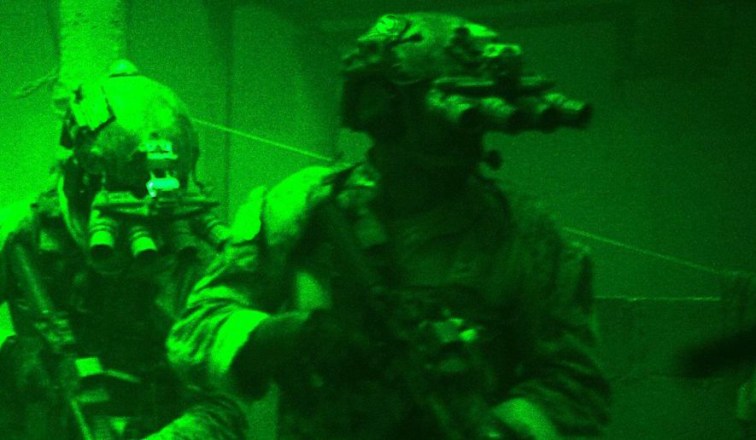
Of his friends and colleagues in the Extractor there was no sign. Hasenkamp’s escort pulled him to one side. Putting his hand over his microphone he whispered in his captive’s ear: “Where is everyone?” Hasenkamp was still gagged and could only shrug. He was rewarded with a heavy slap. Clearly his escort resented his guard detail and would have preferred running around with his mates.
The assaulters were swarming up inside the building and searching the offices. They had to use the stairs as the lifts weren’t in operation. Hasenkamp could see the machine was still working, he could see lights and displays, but everything else was dead. Had Brodeur and the rest secretly evacuated the silo while he’d been out there? He realised he was still thinking straight but how long before he started to feel the ill effects produced by the machine?
One by one the soldiers made their reports over their radios. “First floor secure,” “Second floor secure,” etc. until it was the turn of the fifth floor. Here the trooper had run round checking the empty offices. Then he rested for a moment leaning on the balcony. He even bent double, trying to get his breath back. He looked along the gantry next to him and saw that where it met the machine there was a lighted screen. Warily, he began to walk towards it. He swung his gun (how heavy it seemed) from left to right in readiness, in case the light was some kind of diversionary tactic or trick.
When he reached the screen he looked around him until he felt secure enough to look at what had attracted his attention. The screen was surrounded by dials and buttons. He knew better than to touch any of them but he was interested in the illuminated screen. He turned off his NVGs to see what it said. One word flashed on and off: WAR.
This would be the last word the man would ever read. Goggles on, he slowly returned to the gallery around the fifth floor. By now the emanations from the machine behind him were seriously interfering with his perception. The word he had just seen had lost its meaning. Individual letters of the alphabet were blurring into squiggles. He stood motionless, feeling lost. The idea of making a report over his radio never entered his head.
This was ‘War’ not ‘Spy’ and there was a big difference between Scott Scandole’s incursion into the Parisian Institut Baudrillard and Seal Team Six’s attack on the silo. Scott had worn a borrowed lab coat; each of the assaulters was encased in sophisticated body armour and carrying deadly ordnance. But when dealing with the emanations from the machine they were just as naked.
Hays, in the vanguard as usual, had got as far as the top floor. He didn’t like the way his breathing was laboured after the climb. He might have been old for Special Ops but he was fit. He didn’t usually feel his breath going in and out of his lungs. He tore the respirator form his face. It made no difference but his microphone was dislodged too. He could no longer issue orders but he was losing the ability to formulate any. In the oppressive silence Hays felt a headache coming on.
He wasn’t the only one. Proximity to the machine was affecting every member of Silver Squadron. Initial disorientation had turned to disquieting shifts of perception. For some the silo seemed a bizarre space, impossibly high, full of the machine, an alien artefact constructed using strange geometries. For all of them the green world through which they moved was becoming palpably hostile.
Every sense was heightened. Sounds were amplified and seemed to be experienced within their heads. Boots clattered on the metal floors. Their increasingly ragged breathing rasped and wheezed. The recycled air in the respirators tasted stale. In direct contravention of orders some men pulled them from their faces to inhale the untested air of the silo. The body armour chafed and their helmets were so heavy the once so proud soldiers could hardly lift their heads.
One man, stomping around the third floor, could feel his fingertips scratching against the fabric of his gloves. His trigger finger was literally itchy. To relieve it he squeezed the trigger of his MK416 and sprayed bullets in a wide arc until he found something to aim at. The first fatality was a result of this very first round. The body armour wasn’t meant for protection from a hail of bullets at this range and the man was nearly cut in two.
The firing of this automatic weapon in such a confined space had a profound impact on the men of Silver Squadron. Instinct took over, the fight response kicked in and the shooting began.
Each assault rifle could fire 900 rounds a minute and every man was firing. The air was full of bullets and ricochets. On every floor men were being cut down in the most brutal fashion by what is known as ‘friendly fire’. Over the headsets one voice was repeating “no quarter” over and over until words lost all meaning and the men were left with snarls and grunts. They were cornered, crazed with fear. That’s when Hays fitted his AG1416 40mm grenade launcher to his tactical rail. It wasn’t long before the exploding grenades drowned out the animal noises and even the screams.
The noise was deafening. Glass shattered, grenades tharumped against brick and metal. Whole gantries were blasted into the air to fall and smash on the floor far below. Soldiers plunged with them, screaming all the way down. The ground floor of the silo was filling up with twisted metal and bodies.
Among them was Hasenkamp. As soon as the shooting began his instinct took control and he dropped to the floor. He was unarmed and unprotected. He covered his head with his hands in a futile gesture of self-defence. But he was lucky. His guard was one of the first to die. For the first time the forced intimacy of his escort worked in his favour. He pulled the corpse on top of him. He could still feel the kicks as the occasional bullet hit his human shield. But then he ceased to connect the cause (bullets) with the effect (the thing above him twitching). Soon he longer knew who he was. More debris and bodies fell on him but he only knew he couldn’t move. He lay there with his mind unhinging.
None of Silver Squadron was left alive. The last man standing was the doorkeeper. When the shooting started he stayed at his post and killed three men who ran towards him trying to escape. But the vestiges of his training were leaving him. He no longer knew whose side he was on. Then he wasn’t on any side at all. He threw down his weapon and ran outside. He fell in the river and drowned.
Outside the silo the men of Black Squadron were unaffected by the machine. They were still obeying orders and under no circumstances would compromise the mission by attempting to enter the building themselves.
Those men close by and lurking in the bushes heard the gunfire going on inside. The explosion of the grenades could be heard even inside the Wilmington Café where Parmenter was waiting. He was worried. Anything other than silence was noise and noise on a mission like this could be the sound of defeat. The quiet that followed the engagement was equally unsettling. He sat in one of the booths staring at his radio, gradually giving up hope of a call from Hays.
Inside the silo, effectively now a charnel house, the silence was broken by the sounds of bolts being unscrewed. No one was there to see a panel open up in the side of the machine and Pierre Brodeur step through and look about him. Smoke drifted above the wreckage and the bodies. I suppose, Brodeur thought, this is what it means to be left in possession of the field. It was awful. Far too many people had found themselves in death alignments. Brodeur’s body shuddered with the horror of it all. This was what happened when a bad genre came home. More of the Institut emerged from the secret room which led to the excavated underground chamber where they had lived for the last few days.
Brodeur pointed up at the machine. It had lost all its gantries and was pitted and dented and blackened by the explosions. But lights were still flickering. The machine was still functioning.
“What will it take to shut this damned thing down?”
 pig productions